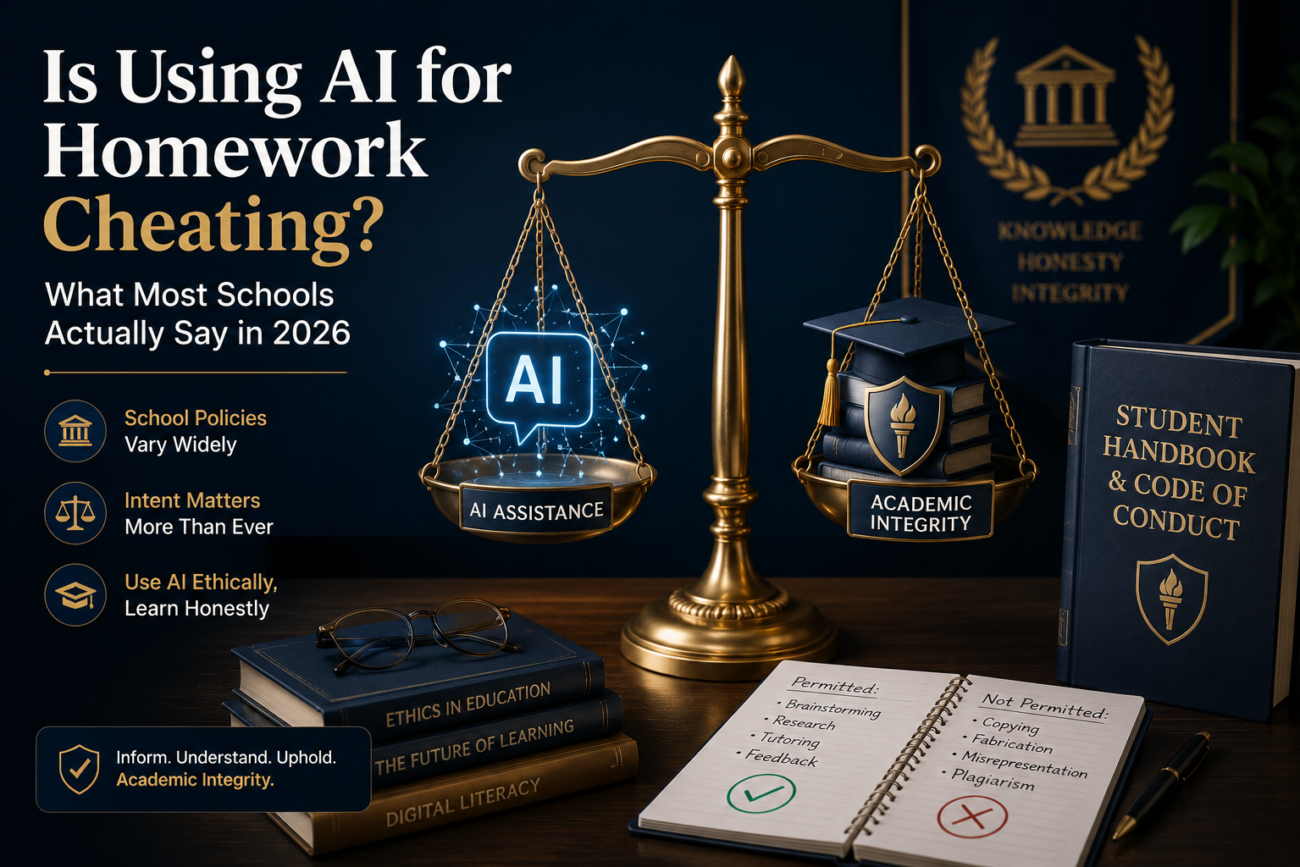
The question students are searching for most right now: Is using AI for homework cheating? The honest answer in 2026 is that it depends on your school, your teacher, the specific assignment, and how you use it. Most schools have now published AI policies, but what they say varies enormously. Here’s what institutions across education levels actually say, what the common patterns are, and how to navigate this without guessing wrong.
The Short Answer: It Depends on Three Things
Before looking at what specific schools say, it helps to understand the three variables that determine whether AI use is considered cheating in any given situation:
- Your school or institution’s explicit policy — increasingly, schools have written AI policies. If yours does, that policy overrides any general guidance anyone else gives you.
- Your teacher’s specific instructions for the assignment — many teachers now state their AI stance in assignment briefs. A teacher’s stated expectation carries more weight than school-wide policy for that specific task.
- How you used the AI — there’s a significant difference between using AI to understand a concept (generally accepted) and using AI to generate content you submit as your own (generally not accepted). Our guide on how to use ChatGPT for studying without cheating covers this distinction in full.

What Universities Are Actually Saying in 2026
Most major universities now have explicit AI policies, and they cluster into four broad approaches:
1. Blanket prohibition (becoming less common)
Some institutions prohibit AI use entirely for assessed work, treating it the same as plagiarism. Students submitting AI-generated content can face the same consequences as submitting someone else’s work — academic probation, failed grades, or expulsion in serious cases. This approach is most common in institutions that haven’t yet developed nuanced policies, and it’s becoming less prevalent as AI use in professional life normalises.
2. Use permitted with disclosure (the growing standard)
A growing number of universities permit AI use but require students to disclose it, similar to citing a source. Students note which parts of their work involved AI assistance, how they used it, and what they contributed themselves. This approach acknowledges that AI is a real tool students will use professionally while maintaining transparency about how the work was produced.
3. Task-specific rules (most nuanced approach)
Many universities now set AI rules at the assignment level rather than institution-wide. A research essay might prohibit AI-generated text while permitting AI for research assistance. A coding assignment might allow AI autocompletion for syntax but require original algorithmic thinking. This approach is most common at institutions with engaged faculty who’ve thought carefully about what each assignment is actually designed to develop.
4. Actively encouraged use (vocational and professional programmes)
Some programmes — particularly in business, technology, and professional fields — actively incorporate AI tools into coursework on the grounds that students will be expected to use them in their careers. Students are assessed on how effectively they use AI alongside their own judgment, not on producing work without it.
What High Schools and Secondary Schools Are Saying
At the secondary level, policies are more variable and often less clearly communicated than at the university. Research from education organisations in 2024–2025 shows a consistent pattern:
- Most schools have some form of AI policy, but many students haven’t read it or weren’t clearly told about it
- Teacher approaches within the same school vary widely — one teacher may explicitly permit AI assistance, while another in the same department prohibits it
- The most common explicit prohibition is AI-generated essays and written assignments submitted as the student’s own work
- Research assistance, concept explanation, and study tools like flashcard generation are rarely specifically prohibited and often fall into a grey area
The practical implication for secondary students: assume your school prohibits submitting AI-generated content as your own work unless told otherwise, but that using AI to understand material and study is generally acceptable. When in doubt about a specific assignment, ask the teacher directly.
What AI Detection Actually Does — and Doesn’t Do
Many students wonder whether using AI for homework will be detected. The honest answer in 2026 is that AI detection tools exist but are unreliable — they produce both false positives (flagging human writing as AI) and false negatives (missing AI-generated content).
Turnitin, the most widely used academic integrity tool, added AI detection in 2023. It identifies patterns associated with AI-generated text, but has a meaningful false positive rate — human writers with formal styles or non-native English speakers have been incorrectly flagged. GPTZero and similar tools have similar limitations.
The practical upshot: don’t make decisions about AI use based on whether you think you’ll get caught. Make them based on your school’s policy and whether the use genuinely supports your learning. Detection uncertainty cuts both ways — students who use AI appropriately can be wrongly flagged, and students who misuse it are not reliably caught.
The Types of AI Use That Are Almost Never Considered Cheating
Across virtually all school and university policies, these uses are either explicitly permitted or so broadly accepted that they’re not addressed in prohibitions at all:
- Using AI to understand a concept explained poorly in a textbook or class — this is the digital equivalent of asking a tutor or a more knowledgeable friend
- Generating practice questions to quiz yourself on material — active recall using AI-generated questions is a study technique, not an academic integrity issue
- Summarising material you’ve already read for study purposes — creating revision notes from your own reading using AI assistance
- Checking grammar and spelling on work you’ve written — generally treated the same as using a grammar checker or asking someone to proofread
- Using AI to research a topic before forming your own argument — research assistance, like using any other reference tool
The Types of AI Use That Are Almost Always Considered Cheating
These uses are explicitly prohibited in the vast majority of policies that have addressed AI:
- Submitting AI-generated essays, reports, or written work as your own — the most commonly prohibited use across all education levels
- Using AI to complete and submit answers to individual assessed assignments — particularly for work where individual performance is what’s being measured
- Pasting exam or quiz questions into AI during an assessment — prohibited under virtually every academic integrity policy
- Submitting AI-generated code as your own programming work — specifically addressed in many computer science programmes
- Generating and submitting fake citations or references — not just a policy violation, but actively risky, as AI-generated citations are frequently fabricated entirely
How to Find Out What Your Specific School Actually Says
Rather than relying on general guidance, here’s how to get a definitive answer for your situation:
- Check your student handbook or academic integrity policy — most are available on the school or university website under “academic integrity,” “academic honesty,” or “student conduct”
- Check the assignment brief or syllabus — many teachers now include explicit AI guidance at the assignment or course level
- Email your teacher directly with a specific question — “For this essay, is it acceptable to use ChatGPT to get feedback on my draft?” is a question most teachers will answer clearly and appreciate being asked
- Check whether your institution uses Turnitin or a similar tool — if so, your institution almost certainly has an explicit policy on what AI use means for submitted work
A Practical Framework for Every Assignment
If you want a simple test to apply to any AI use before doing it, ask yourself these three questions:
- Does my school or teacher explicitly prohibit this? If yes, don’t do it regardless of anything else.
- Am I submitting AI output as my own original work? If yes, this is almost certainly prohibited at most institutions.
- Would I still be able to do this task without AI if I had to? If no — if the only reason you can complete the assignment is that AI did the core work — that’s a signal that the use has crossed from assistance into substitution.
For more on drawing that line in practice, see our complete guide on how to use ChatGPT for studying without cheating and our guide for parents on the AI tools parents are using to help their kids study.
Frequently Asked Questions
Is using AI for homework cheating in 2026?
Not automatically — it depends on your school’s policy, your teacher’s instructions, and how you used it. Using AI to understand material and study is widely accepted. Submitting AI-generated content as your own work is considered academic dishonesty at most institutions. Check your specific school policy rather than relying on a general answer.
Do schools actually check for AI in homework?
Many do — Turnitin and similar tools now include AI detection features used by a large proportion of secondary schools and universities. However, these tools are not fully reliable, producing both false positives and false negatives. Don’t base your decisions on detection likelihood — base them on your school’s policy and your own academic integrity.
What happens if I’m caught using AI for homework?
Consequences vary by institution and severity, ranging from a failed grade on the assignment to course failure to formal academic misconduct proceedings. Most schools treat AI misuse similarly to plagiarism under their existing academic integrity frameworks. First-time incidents with minor assignments are typically handled more leniently than repeated or serious violations.
Can I use ChatGPT to help me understand homework without it being considered cheating?
Yes, in almost all cases, using ChatGPT to explain a concept, answer questions about material you’re studying, or quiz you on content you’re studying is not cheating. The line is submitting AI output as your own work or having AI complete assessed tasks that are meant to demonstrate your own ability.
Should I tell my teacher if I used AI for an assignment?
If your school has a disclosure requirement, yes — absolutely. If there’s no specific requirement, it depends on the extent of use. Using AI to check your grammar generally doesn’t require disclosure; using AI to substantially shape your essay’s structure and content is the kind of use worth being transparent about, both for integrity reasons and because your teacher may ask about your process.
Are AI policies different for university versus high school?
Generally, universities have more explicit and detailed policies, partly because they’ve been under more pressure to address AI since 2023. High school policies are more variable — some are very clear, many are not. University assignments also tend to be weighted more heavily, making the stakes of misuse higher. The core principles are similar at both levels; the specifics need to be checked for your particular institution.
Is using AI for homework cheating? The question itself is becoming less useful than a more specific one: is this specific use, for this specific assignment, at this specific school, something my teacher would consider a violation of academic integrity? That’s the question worth asking — ideally, directly to your teacher, before submitting, not after.
