Millions of people use ChatGPT every day — but very few understand what actually happens when they type a question and get an answer back. So, how does ChatGPT work? In this simple explanation, we’ll walk through the technology from training to text generation, in plain English with no jargon required.
What ChatGPT Actually Is
ChatGPT is a large language model (LLM) — a type of AI trained to understand and generate human language. It was built by OpenAI and is based on an architecture called the Transformer, first introduced in the landmark 2017 paper “Attention Is All You Need” by Google researchers.
The simplest way to think about it: ChatGPT is a very sophisticated text prediction engine. It doesn’t think or feel. Instead, it’s extremely good at predicting what text should come next, based on patterns it learned from reading an enormous amount of written material.
How ChatGPT Was Trained
Understanding how ChatGPT works starts with understanding how it was trained. The process happened in two main stages:
Stage 1 — Learning from text
ChatGPT was fed an enormous dataset of textbooks, websites, articles, code, Wikipedia, forums, and more — totalling hundreds of billions of words. During this pre-training phase, the model learned patterns: which words tend to follow which other words, how sentences are structured, how arguments are built, and how questions get answered.
The model isn’t taught facts explicitly — it absorbs patterns. This is why ChatGPT can write in the style of a legal document, a children’s book, or a Python script: it has seen millions of examples of each.
Stage 2 — Learning to be helpful and safe
After pre-training, OpenAI used a technique called Reinforcement Learning from Human Feedback (RLHF). Human reviewers rated different responses — preferring answers that were helpful, accurate, and safe. The model adjusted to produce more responses like the ones humans preferred. The pre-training gave it language ability; RLHF shaped its behaviour into something that actually feels like a helpful assistant.
How Does ChatGPT Work When You Send a Message?
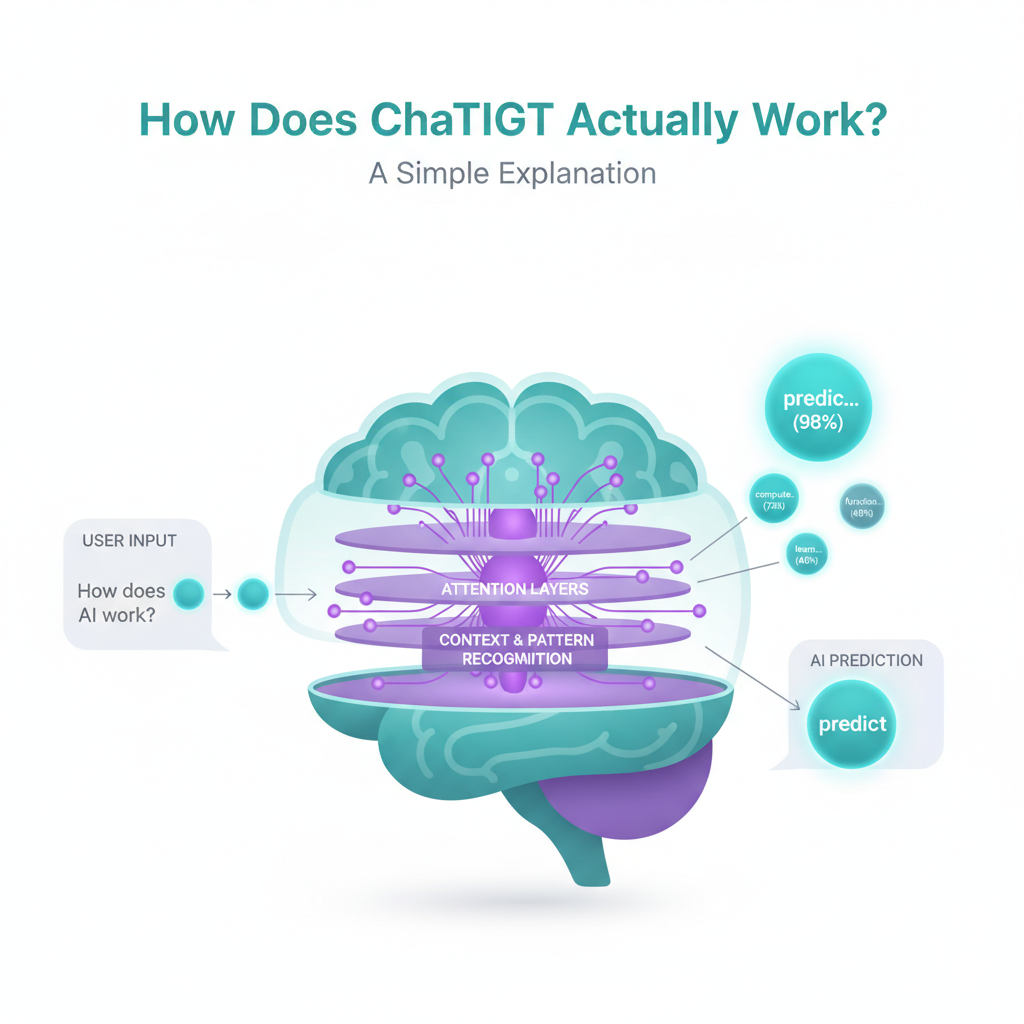
Here is exactly what happens, step by step, every time you type something into ChatGPT:
- Your message is broken into tokens. ChatGPT doesn’t read whole words — it reads tokens, which are chunks of text roughly corresponding to parts of words. “Unbelievable” might become three tokens: “un”, “believ”, “able”. Tokenisation converts language into units the model can process mathematically.
- Tokens are converted to numbers. Every token is represented as a long list of numbers called a vector. This turns language into something the model can calculate with.
- Attention calculations run. The Transformer architecture uses a mechanism called “attention” to figure out which parts of your message are most relevant to each other. In the sentence “The cat sat on the mat because it was soft,” attention helps the model understand that “it” refers to “the mat,” not “the cat.”
- The next token is predicted. Based on all of this processing, ChatGPT predicts the single most appropriate next token — then the one after that — then the one after that. Your entire response is generated one token at a time, very quickly.
- Tokens are converted back to text. The numbers are translated back into readable words and streamed to your screen as you watch.
This token-by-token generation is why ChatGPT’s responses appear word by word rather than all at once — each word is being predicted in sequence, live, as you wait.
Why ChatGPT Hallucinates — And Gets Things Wrong
One of the most important things to understand about how ChatGPT works is why it sometimes confidently states things that are completely wrong. This is called hallucination, and it’s a direct consequence of the underlying technology.
Because ChatGPT generates text by predicting likely patterns — rather than looking facts up or reasoning logically — it can produce text that sounds authoritative but is factually incorrect. The pattern fits even if the fact doesn’t. A fake book citation, a wrong date, a made-up statistic: all can be delivered with the same confident tone as a correct answer.
Other common limitations that stem from how ChatGPT works:
- Knowledge cutoff — its training data has a cutoff date, so it doesn’t know about recent events unless web search is enabled.
- Weak maths — language pattern prediction is not the same as calculation. ChatGPT can make arithmetic errors on problems that look simple.
- Inconsistency — ask the same question twice, and you may get different answers, because the generation process involves statistical variation.
Understanding this helps you use ChatGPT more effectively: it’s excellent for drafting, summarising, explaining, and brainstorming — but anything factual that matters should be verified independently. If you’re wondering what not to use AI tools for, factual research without verification is near the top of the list.
How ChatGPT Is Different From a Search Engine
A common question from people learning how ChatGPT works is: how is it different from Google? The difference is fundamental:
- Google retrieves. It finds existing web pages and ranks them. It doesn’t create new text — it points you to text that already exists.
- ChatGPT generates. It creates new text from scratch, based on patterns. It’s not retrieving an answer from a database — it’s composing one in real time.
This is why ChatGPT can write a poem, draft a job offer letter, or explain a complex concept simply — tasks that search engines can’t do. It’s also why ChatGPT shouldn’t be your first choice for checking current facts or breaking news. For a broader look at how AI assistants compare, see our guide to the friendliest AI tools for different users.
What ChatGPT Is Good At — and What It Isn’t
Now that you understand how ChatGPT works under the hood, here’s a practical summary of where it excels and where to be careful:
- Great for: drafting emails and documents, summarising long text, explaining concepts in simple terms, brainstorming ideas, writing code, translating languages, and creative writing.
- Use with caution: medical or legal advice (always verify with a professional), current news and recent events, precise calculations, and anything requiring a cited source.
- Avoid relying on it for: real-time information without web search enabled, highly sensitive personal decisions, or any task where a confident-sounding wrong answer would cause serious harm.
For more on safe and smart AI use, read our guide on what a system prompt is and why it changes AI behaviour.
Frequently Asked Questions
How does ChatGPT work in simple terms?
ChatGPT was trained on hundreds of billions of words and learned patterns in language. When you type a message, it predicts the most appropriate response one token at a time, based on those patterns. It doesn’t look things up or think — it generates text that fits the context of your input.
Does ChatGPT actually understand what I’m saying?
Not in the way humans understand things. ChatGPT processes patterns in language and produces contextually appropriate responses, but it doesn’t have genuine comprehension, beliefs, or awareness. It can appear to understand because its pattern recognition is extremely sophisticated.
Why does ChatGPT make things up?
It generates text by predicting likely patterns rather than retrieving verified facts. When a confident-sounding but false answer fits the statistical pattern of the training data, the model produces it anyway. This is called hallucination and is one of the most important limitations to understand about how ChatGPT works.
How does ChatGPT know so much?
It absorbed patterns from an enormous training dataset — hundreds of billions of words from across the internet, books, and other sources. It didn’t memorise facts; it learned relationships between concepts well enough to reproduce and recombine them convincingly.
Is ChatGPT the same as AI?
ChatGPT is one type of AI — specifically, a large language model. AI is a broad field covering many different technologies. ChatGPT is currently one of the most visible examples of AI, but it represents just one category within a much larger field.
Can ChatGPT learn from our conversations?
Not in real time. The model itself doesn’t update based on individual conversations. OpenAI may use conversation data to improve future versions of the model, subject to their privacy policy and your account settings, which you can adjust in ChatGPT’s settings panel.
Understanding how ChatGPT works doesn’t require a computer science degree. At its core, it’s a system that learned language by reading vast amounts of text and now uses those patterns to generate helpful, coherent responses one token at a time. The more you understand the technology, the better you can use it — and the better you’ll know when to trust it and when to double-check.
