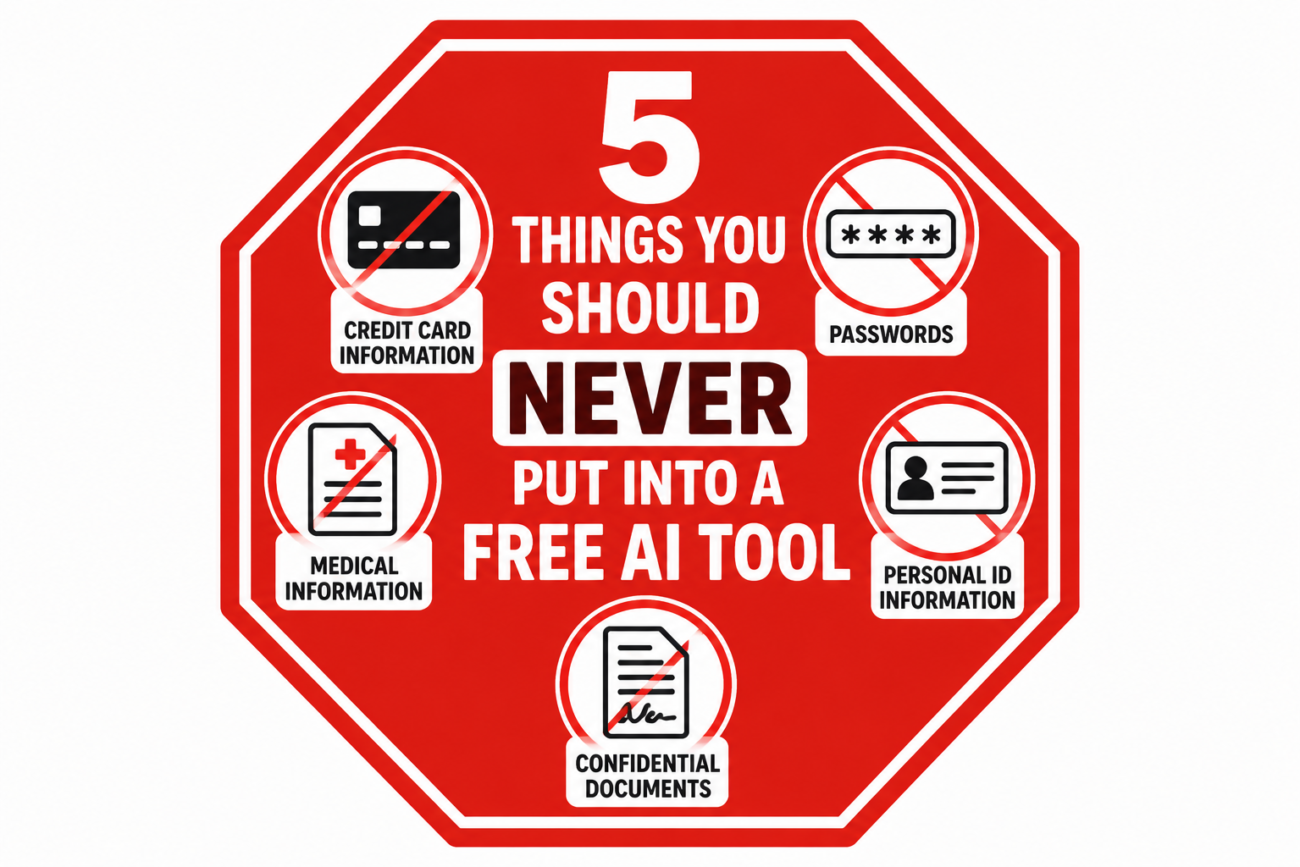
Free AI tools like ChatGPT, Gemini, and Claude are genuinely useful — but most people don’t stop to think about what happens to the information they type in. Before you paste something sensitive into a free AI tool, there are five categories of information you should never share. Getting this wrong can expose your data, your clients, or your business in ways that are very hard to undo.
Here are the things you should never put into a free AI tool, and why each one carries real risk.
1. Passwords and Login Credentials
This one sounds obvious, but it happens more than you’d think. People paste error messages, account setup instructions, or IT documents that contain passwords directly into AI chat windows. Some users even ask the AI to “help them remember” login details by storing them in a conversation.
Free AI tools are not password managers. Your inputs may be stored, reviewed for safety, or used to improve the model. Even if the platform says it doesn’t train on your data by default, that setting can be easy to miss or change. Keep all credentials out of AI tools entirely — use a dedicated tool like Bitwarden instead.
2. Personal Identifiable Information (PII)
Personal identifiable information — full names combined with addresses, national ID numbers, dates of birth, phone numbers, or financial details — should never go into a free AI tool. This applies to your own information and especially to information about other people.
If you work in healthcare, legal services, finance, or HR, sharing client PII with a free AI tool may also violate GDPR, HIPAA, or other data protection regulations. Even a well-intentioned “can you help me write a letter to John Smith at 42 Oak Street about his overdue account” can expose you to serious legal risk.
Before sharing any personal details, anonymise them. Replace real names with “Client A,” replace addresses with “123 Example Street,” and strip out any identifying numbers.
3. Confidential Business Information
Unreleased product plans, internal financial data, HR documents, proprietary processes, client contracts — these are among the things you should never put into a free AI tool. Free tiers of AI platforms typically have broader data usage rights than enterprise or paid tiers.
In 2023, Samsung engineers famously leaked internal semiconductor data by pasting it into ChatGPT. The incident became a high-profile lesson in how quickly confidential information can leave a company. If your business has a data policy, check it before using any AI tool — many companies now explicitly prohibit staff from entering proprietary information into public AI systems.
For business use cases involving sensitive data, look for enterprise AI options with clear data processing agreements and opt-out training policies.
4. Other People’s Creative Work Without Permission
Pasting a colleague’s unpublished article, a client’s draft, or a contractor’s creative work into an AI tool to “improve it” or “get feedback” may violate their intellectual property rights — especially if they haven’t consented to their work being processed by a third-party platform.
This is one of the less-discussed things you should never put into a free AI tool, but it’s increasingly relevant as AI use grows in creative industries. Always get explicit permission before submitting someone else’s work to an AI platform, and check whether their contract or your NDA covers this scenario.
5. Anything You Wouldn’t Want Made Public
A simple rule of thumb: if you’d be uncomfortable seeing your input on a public website, don’t type it into a free AI tool. This includes venting about colleagues by name, discussing legal disputes, sharing medical symptoms with identifying details, or describing personal situations involving other people.
Free AI platforms can and do use conversation data to improve their models, conduct safety research, or investigate misuse. Even platforms with opt-out options are not fully private in the way a private conversation or a secure document is. If something is sensitive enough to matter, keep it out.
What to Do Instead
None of this means you can’t use AI productively — it just means being deliberate about what you share:
- Anonymise before you paste. Remove names, addresses, numbers, and any identifying details before putting information into a free AI tool.
- Use paid or enterprise tiers for sensitive work. Paid plans from OpenAI, Anthropic, and Google typically offer stronger privacy controls and clearer data agreements.
- Read the privacy settings. Most platforms let you turn off training on your conversations. It takes 30 seconds and makes a real difference.
- When in doubt, leave it out. The AI will still be useful for 95% of tasks without needing your sensitive information.
Frequently Asked Questions
What are the main things you should never put into a free AI tool?
The five key categories are: passwords and login credentials, personal identifiable information (PII), confidential business data, other people’s creative work shared without permission, and anything sensitive you wouldn’t want made public.
Is it safe to use ChatGPT or Claude for work?
It depends on the type of work. For general writing, research, and brainstorming with no sensitive data involved, free AI tools are generally safe. For anything involving client data, proprietary business information, or regulated data, use an enterprise plan with a signed data processing agreement.
Do free AI tools store your conversations?
Most do by default. Platforms like ChatGPT and Claude store conversations and may use them to improve their models unless you opt out in your privacy settings. Check the privacy settings of any AI tool you use and disable data training if the option is available.
Can I get in legal trouble for putting client data into a free AI tool?
Yes, potentially. In regions covered by GDPR, HIPAA, or similar regulations, sharing personal data with a third-party AI platform without the appropriate legal basis or data processing agreement can constitute a data breach. Always check your obligations before sharing client information with any AI tool.
What’s the safest way to use AI tools for sensitive tasks?
Anonymise data before sharing, use enterprise-grade AI tools with strong data agreements for sensitive work, and keep a standing rule that passwords and regulated personal data never go into any AI tool regardless of tier or plan.
AI tools are powerful, but they work best when you’re thoughtful about what goes in. Keeping sensitive information out of free platforms is one of the simplest habits you can build — and one of the most protective ones for yourself, your clients, and your business.
