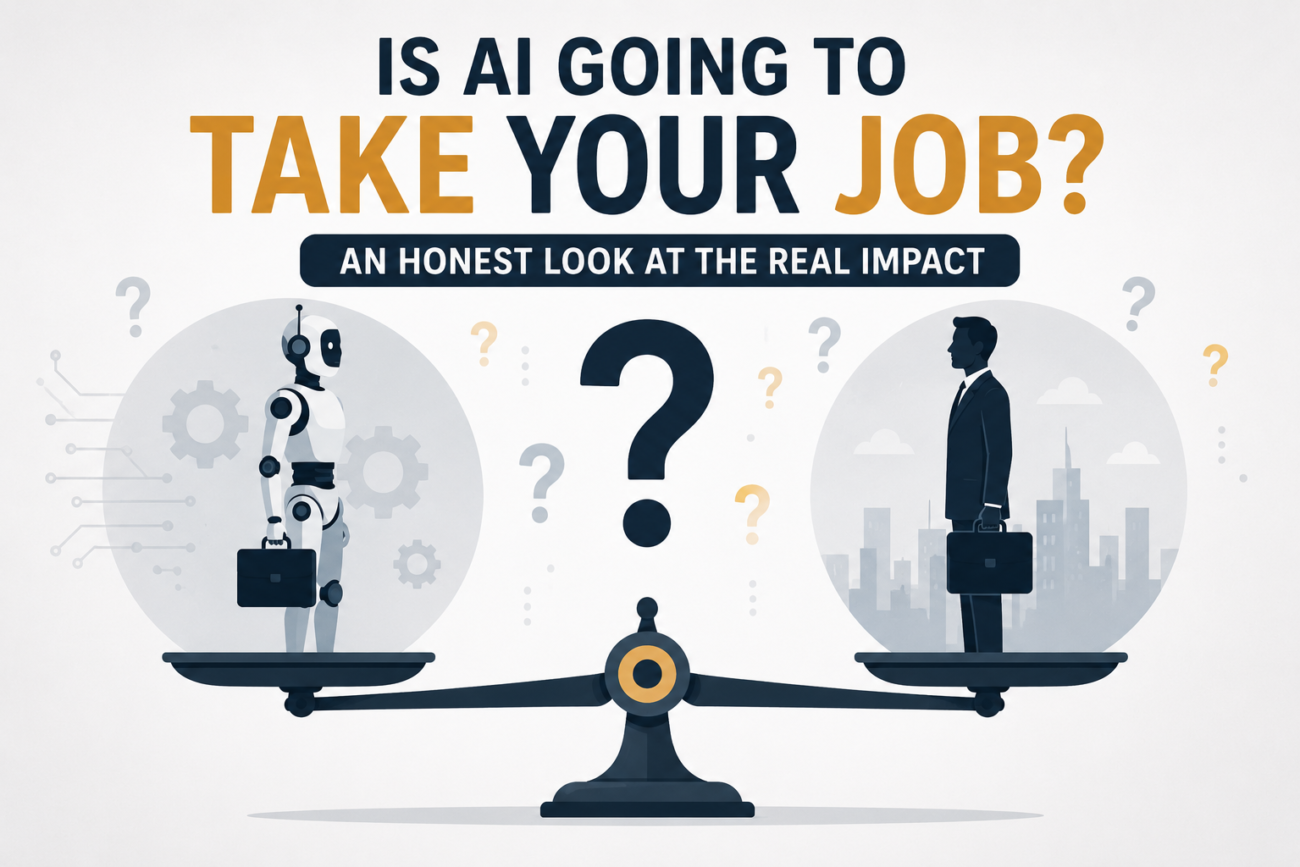
It’s the question on everyone’s mind right now. Is AI going to take your job? The honest answer is: it depends on what you do — and how you respond. Some jobs face genuine disruption. Others are surprisingly safe. And for most people, the reality is more nuanced than either the panic or the reassurance suggests. Here’s what the research actually shows, and what it means for you.
Is AI Going to Take Your Job? What the Research Says
The most widely cited analysis comes from Goldman Sachs, which estimated in 2023 that generative AI could automate tasks equivalent to 300 million full-time jobs globally. That sounds alarming — but the same report noted that most of those jobs wouldn’t disappear entirely. Instead, specific tasks within those jobs would be automated, changing the nature of the work rather than eliminating it.
A separate analysis by McKinsey Global Institute found that up to 30% of hours currently worked across the US economy could be automated by 2030 — but also that AI would create significant demand for new roles that don’t yet exist at scale.
The pattern from previous waves of automation holds here too: technology tends to change jobs more than it eliminates them, at least over the medium term. But that doesn’t mean the transition is painless — and it doesn’t mean every job is equally safe.
Jobs Most at Risk From AI
AI is particularly good at tasks that are repetitive, rule-based, language-heavy, or pattern-recognition-driven. The roles most exposed right now include:
- Data entry and processing — AI handles structured data tasks faster and more accurately than humans. Roles built primarily around moving, categorizing, or formatting data are highly vulnerable.
- Basic copywriting and content production — AI can produce first drafts, product descriptions, social media posts, and templated content at scale. Junior content roles with no strategic or creative differentiation are under pressure.
- Customer service and support — AI chatbots now handle a significant proportion of tier-1 support queries. Roles that primarily respond to predictable, scripted questions face real disruption.
- Paralegal and legal document review — contract analysis, document review, and case research are areas where AI tools are already being deployed in law firms at scale.
- Basic accounting and bookkeeping — routine financial data processing, invoice handling, and reconciliation are increasingly automated.
- Translation — while specialist literary or legal translation remains a human skill, commodity translation work has been largely displaced by AI tools.
Jobs That Are Safer Than You Think
Not every role is at risk — and some are growing precisely because of AI adoption. Jobs that require physical presence, human judgment, emotional intelligence, or complex real-world interaction are significantly harder to automate:
- Trades and skilled manual work — electricians, plumbers, carpenters, and other tradespeople operate in unpredictable physical environments that AI cannot navigate. Demand for skilled trades is rising, not falling.
- Healthcare — nurses, doctors, therapists, and caregivers require human judgment, physical assessment, and emotional connection that AI cannot replicate. AI assists these roles; it doesn’t replace them.
- Education and teaching — effective teaching requires relationship-building, reading a room, and adapting in real time to individual students. AI is a useful tool for teachers; it’s not a teacher.
- Leadership and management — decisions involving people, culture, ethics, and organizational politics require human judgment. AI can inform these decisions; it can’t make them responsibly.
- Creative direction and strategy — generating content is one thing; knowing what content to create, for whom, and why requires strategic and cultural understanding that remains human.
- Social work and counselling — roles built around human vulnerability, trust, and emotional support are among the most AI-resistant in existence.
The Jobs Being Created by AI
Every major wave of automation has created new categories of work. AI is no different. Roles that barely existed five years ago are now in high demand:
- AI prompt engineers — specialists who know how to craft instructions that get the best results from AI tools. If you’re curious about this, our guide on what a system prompt is is a useful starting point.
- AI trainers and evaluators — humans who review, rate, and improve AI outputs to make models more accurate and helpful.
- AI integration specialists — professionals who help businesses adopt and deploy AI tools effectively within existing workflows.
- Data labellers and annotators — AI models require enormous quantities of labelled training data, and much of this work is still done by humans.
- AI ethicists and policy roles — as AI becomes more embedded in society, demand for people who can think carefully about its implications is growing fast.
What You Can Actually Do About It
Understanding the risk is useful. Doing something about it is better. Here are the most practical responses to the question of whether AI is going to take your job:
- Learn to use AI tools in your current role. The biggest near-term risk isn’t “AI replaces you” — it’s “someone who uses AI replaces you.” Getting comfortable with AI tools relevant to your work is the single most protective thing most people can do right now. Our guide on how ChatGPT actually works is a good place to start.
- Identify which parts of your job are automatable. Be honest about which tasks in your role are repetitive and rule-based — those are the ones at risk. Then double down on the parts that require judgment, relationships, and creative thinking.
- Build skills that complement AI rather than compete with it. Critical thinking, complex communication, emotional intelligence, and strategic judgment are all harder to automate — and more valuable in a world where routine tasks are handled by AI.
- Don’t wait for your employer to upskill you. Most organizations are moving slowly on AI training. Taking the initiative yourself — even informally — puts you ahead of most colleagues.
The Honest Bottom Line
Is AI going to take your job? For a small percentage of people — particularly those in highly routine, language-based, or pattern-driven roles — the disruption is real and already happening. For the majority, AI will change the nature of their work significantly over the next five to ten years without eliminating it entirely. And for some, it will create opportunities that didn’t exist before.
The people most at risk are not those whose jobs AI can do — it’s those who refuse to adapt to a world where AI exists. The people best positioned are those who treat AI as a tool to be mastered, not a threat to be feared.
Frequently Asked Questions
Is AI going to take your job completely?
For most people, no, not completely. AI is more likely to automate specific tasks within a job than to eliminate the job entirely. The exception is roles built almost entirely around routine, repetitive, language-based tasks, where displacement is a real risk in the near term.
Which jobs are most at risk from AI?
Data entry, basic content writing, routine customer service, paralegal document review, bookkeeping, and commodity translation are among the highest-risk categories. Any role where the majority of tasks are predictable, repetitive, and rule-based faces meaningful exposure.
Which jobs are safe from AI?
Skilled trades, healthcare, education, counselling, leadership, and creative direction are among the most AI-resistant roles. Jobs requiring physical presence, human judgment, emotional intelligence, or complex real-world interaction are significantly harder to automate.
Will AI create new jobs?
Yes — it already is. AI prompt engineering, AI training and evaluation, integration consulting, and AI ethics roles are all growing. History suggests that technological disruption creates as many jobs as it displaces, though the transition period can be difficult for those in affected roles.
What should I do if I’m worried AI will take my job?
Start by learning to use AI tools in your current role — this is the most protective step most people can take right now. Then identify which parts of your work are automatable and invest in the skills that aren’t: judgment, communication, creativity, and relationship-building.
How quickly is AI going to take jobs?
Faster than previous automation waves in some sectors, slower in others. The disruption in content, customer service, and data processing is already visible. For most professional roles, meaningful displacement is more likely to occur over five to ten years than overnight — giving most people time to adapt if they start now.
Is AI going to take your job? The honest answer is: probably not entirely, but it will change it — and the people who adapt soonest will be the ones best positioned when the dust settles. The time to start is now, not when the disruption arrives at your door.
