Most students aren’t trying to cheat — they’re genuinely unsure where the line is. Learning to use ChatGPT for studying without cheating isn’t about following a list of banned actions; it’s about understanding one core distinction that applies to almost every situation: did the AI do the thinking, or did you? Here’s a clear, practical guide to that distinction, with specific examples of what’s genuinely fine and what crosses the line.
The One Rule That Covers Almost Every Situation
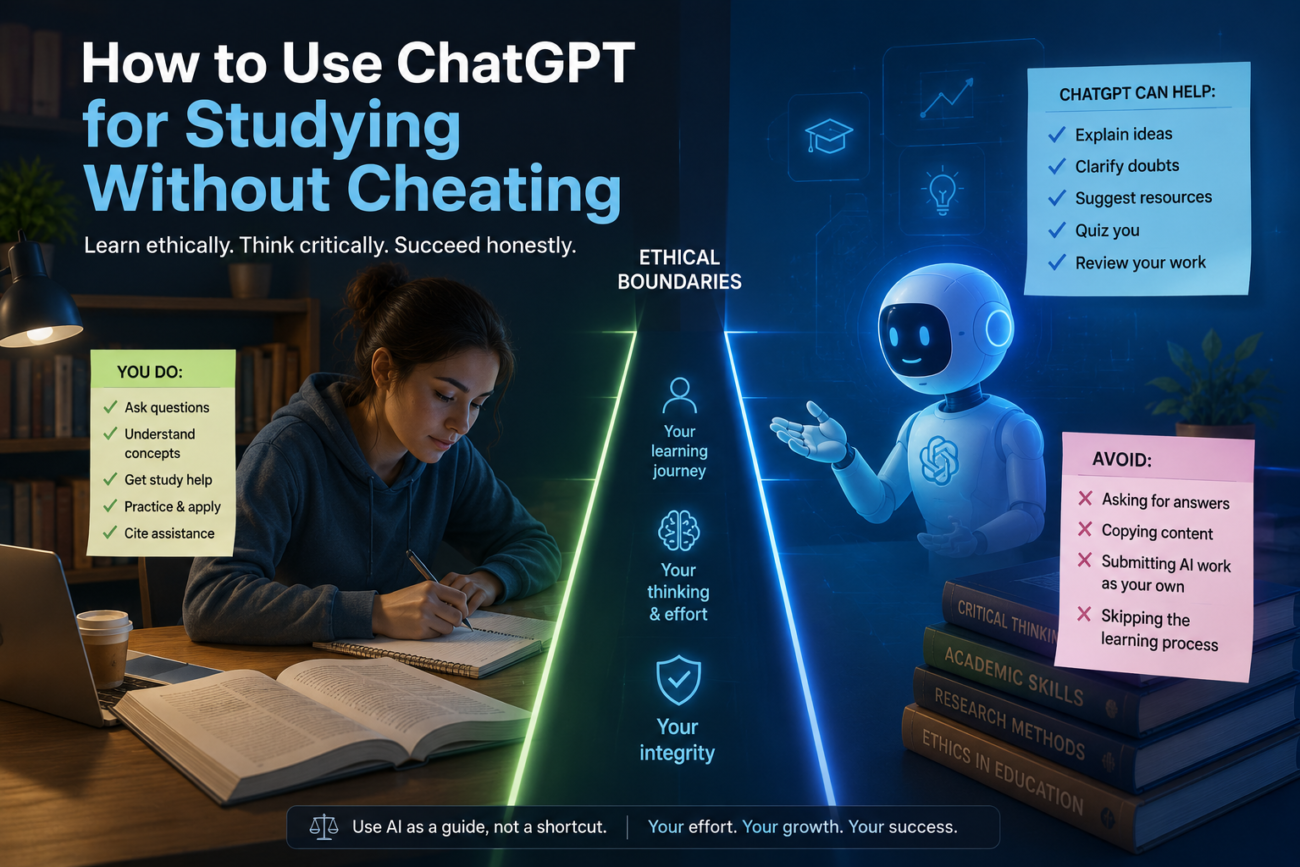
If you remember nothing else from this guide, remember this: using AI to understand something is studying; using AI to produce something you submit as your own work is not.
Asking ChatGPT to explain a concept, quiz you on material, or check your understanding keeps you as the one doing the learning. Asking ChatGPT to write your essay, solve your homework problems, or generate answers you copy directly removes the learning entirely — even if you technically “understand” the output afterward. The test isn’t whether AI was involved. It’s whether you did the thinking that the assignment was designed to make you do.
What Counts as Studying (Genuinely Fine)
Asking ChatGPT to explain a concept you don’t understand
This is one of the most valuable and completely legitimate uses of AI for studying. If your textbook or teacher’s explanation didn’t click, asking ChatGPT to explain it differently — with a different example, a simpler analogy, or more detail — is exactly the kind of use that helps you learn faster without doing anyone’s work for you.
Example prompt: “I don’t understand why the French Revolution led to the Reign of Terror. Can you explain the chain of events in simple terms, with the key turning points?”
Using ChatGPT to quiz yourself
Testing yourself is one of the most effective study techniques that exists, and ChatGPT makes generating practice questions nearly instant. This is studying — you’re still doing the recalling and answering.
Example prompt: “Quiz me on the causes of World War I. Ask me one question at a time and tell me if I’m right after each answer.”
Getting feedback on your own draft
Writing your essay yourself, then asking ChatGPT what’s weak about your argument or where your structure could improve, keeps the actual writing and thinking as yours. The AI is acting as a tutor, pointing out issues — not as the author. For specific prompts that keep this boundary clear, see our guide on how to use AI to improve your essay writing without having AI write it for you.
Summarising material to study from
Uploading your own notes or a textbook chapter and asking for a structured summary to review is a legitimate study technique — you read the material, AI helps you organise and condense it for revision. Our guide on how to use AI to summarize textbook chapters covers the specific prompts that work best.
Checking your own work for errors
Solving a maths problem yourself, then asking ChatGPT to check whether your answer and method are correct, is studying. You did the work; AI is verifying it — similar to checking the answer key at the back of a textbook.

What Crosses the Line Into Cheating
Asking ChatGPT to write your essay or assignment
If you ask ChatGPT to “write an essay about the themes in The Great Gatsby” and submit the output (even lightly edited) as your own, this is straightforwardly academic dishonesty at most institutions. The assignment exists to test your ability to analyse and write — outsourcing that entirely defeats its purpose and is dishonest about whose work you’re submitting.
Getting direct answers to homework problems
Asking “what’s the answer to question 7” and copying it down, without engaging with how to solve it, is functionally the same as copying a classmate’s homework. The difference between this and the “checking your work” example above is whether you attempted the problem first.
Having ChatGPT take an online quiz or test for you
Pasting test questions into ChatGPT during a timed assessment and submitting its answers is cheating in essentially every academic context, regardless of whether the test is open-book or proctored. This applies even to “practice” quizzes if they’re meant to assess your actual knowledge.
Generating citations or sources you haven’t verified
Beyond the ethics question, this carries a serious accuracy risk: ChatGPT can fabricate citations that look completely real but don’t exist. Submitting AI-generated references without checking they’re real isn’t just dishonest — it can result in a paper full of citations to sources that simply aren’t real. Our guide on AI hallucinations explains exactly why this happens.
Translating a language assignment you can’t read yourself
If a language class assignment requires you to write or translate something yourself, having ChatGPT do it and copying the output skips the entire point of the exercise — even if you could explain afterward what it says.
The Grey Area: Where Most Confusion Happens
A few situations genuinely depend on context — your school’s specific policy and your teacher’s instructions matter here more than any general rule:
- Using AI to brainstorm essay topics or angles. Generally fine — brainstorming isn’t the graded skill in most assignments. But if an assignment specifically asks you to generate your own ideas as part of the task, even this could cross a line. Check the assignment’s actual requirements.
- Asking AI to fix grammar and spelling. Usually fine for most assignments, similar to using a spell-checker — but some writing-focused classes specifically assess your raw writing mechanics, in which case heavy AI editing may not be appropriate. Ask your teacher if unsure.
- Using AI to understand a homework problem’s setup before solving it yourself. Generally fine — clarifying what a confusing question is actually asking is different from getting the answer. The key test: did you still do the actual solving?
- Group study using AI together. Usually fine for collaborative review (like quizzing each other using AI-generated questions), but check whether your specific assignment is meant to be individual work.
When genuinely unsure, the simplest solution is to ask your teacher directly: “Is it okay if I use ChatGPT to [specific use case] for this assignment?” Most teachers appreciate the question far more than finding out after the fact that a line was crossed.
Why This Distinction Actually Matters for You — Not Just for Avoiding Punishment
Beyond the academic integrity risk, there’s a practical reason to stay on the studying side of this line: the work you avoid doing is usually the work that builds the skill you’ll need later. Essays build your ability to construct an argument. Maths problems build problem-solving skills that show up again in harder courses. Skipping that practice with AI doesn’t just risk getting caught — it means showing up to the next test, the next course, or the next job without a skill you were supposed to have built.
Students who use AI as a tutor rather than a ghostwriter tend to perform better over time, not worse — because they’re still doing the cognitive work that produces actual learning, just more efficiently and with better feedback along the way.
How to Set Boundaries With ChatGPT to Stay on the Right Side
If you want to build the habit of using AI as a study tool rather than a shortcut, set this expectation at the start of any study session:
“I’m using you to study, not to do my assignment for me. Please don’t write full answers, essays, or solutions for me — instead, explain concepts, ask me questions, give me feedback on my own work, and help me check my understanding.”
This single instruction at the start of a session significantly reduces the chance of accidentally sliding into “just give me the answer” mode when you’re tired or under deadline pressure — which is when most boundary-crossing actually happens, far more often than deliberate cheating.
Frequently Asked Questions
Is using ChatGPT for studying considered cheating?
Not inherently — it depends entirely on how you use it. Using ChatGPT to understand concepts, quiz yourself, or get feedback on your own work is studying. Using it to generate content you submit as your own, or to get direct answers to graded assignments, is generally considered academic dishonesty.
Will my school know if I used ChatGPT?
AI detection tools exist but are not always reliable, and many schools are moving toward policy clarity rather than detection as their primary approach. Regardless of detection risk, the more important question is whether the use violates your specific school’s policy and whether it undermines your own learning — both matter independent of whether you’d get caught.
What’s the difference between getting help and cheating?
Help that leaves you doing the core thinking — understanding a concept, working through a problem, refining your own writing — is legitimate, the same as asking a tutor or classmate for help. Cheating is having someone or something else do the work that you’re meant to submit as evidence of your own understanding.
Can I use ChatGPT to check my homework answers?
Yes, generally — checking your own completed work against AI’s analysis is similar to using an answer key, as long as you attempted the problem yourself first. The line is crossed if you ask for the answer before attempting it and then work backward.
What should I do if I’m not sure whether a use is allowed?
Ask your teacher directly before using AI for that specific assignment. This is almost always better received than guessing wrong, and most teachers will give you a clear answer about what’s acceptable for their specific class and assignment type.
Does using ChatGPT to study actually help me learn better?
Yes, when used as described above — for explanation, self-testing, and feedback. Studies on learning consistently show that active recall and immediate feedback (both of which ChatGPT can provide efficiently) improve retention more than passive review. The benefit comes specifically from staying engaged with the material, not from offloading the thinking.
The honest answer to “is this cheating?” almost always comes down to one question: after using ChatGPT, could you do the task again yourself without it? If yes, you were studying. If the answer only exists because ChatGPT produced it, that’s the line — and crossing it costs you more than a grade. It costs you the skill the assignment was built to give you.
