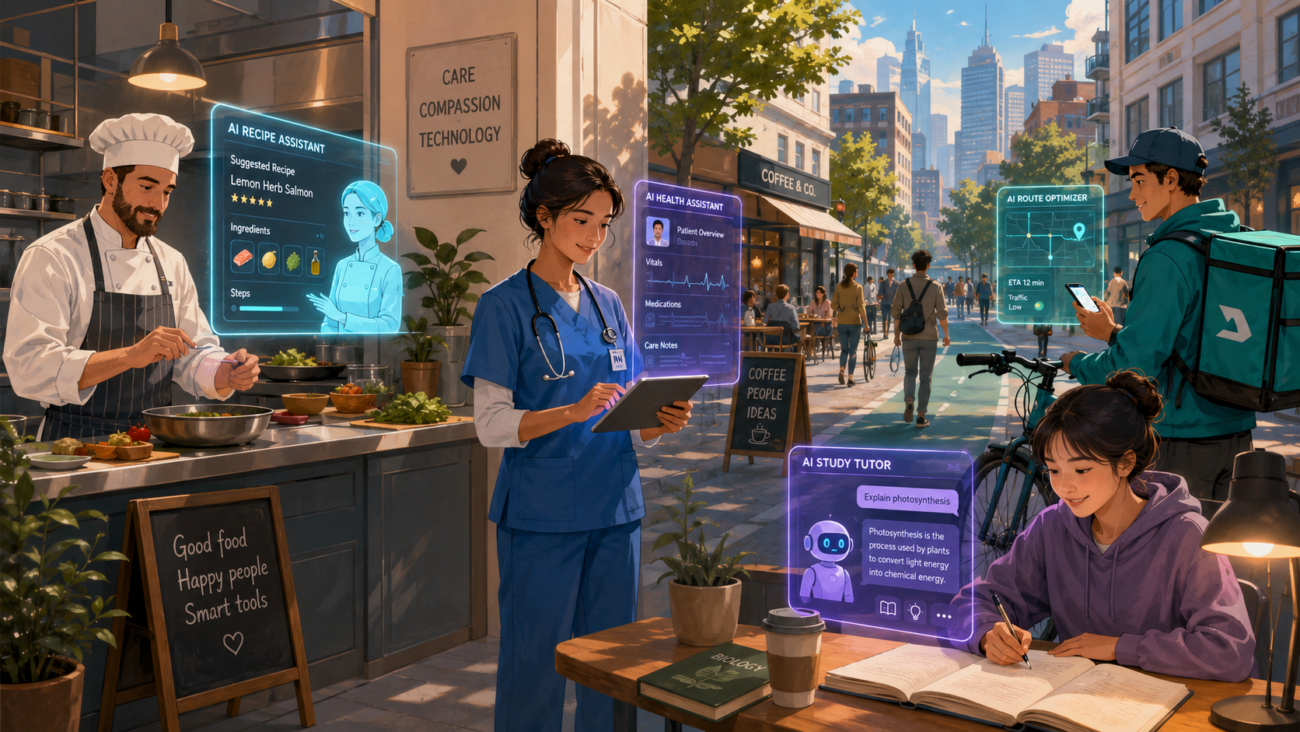
By 2026, AI will have quietly moved from something tech enthusiasts talk about to something millions of ordinary people use every single day. Not for building robots or writing code — but for writing emails faster, planning family meals, understanding confusing documents, and getting answers at 2 am when no one else is available. Here is a genuine look at what regular people are actually using AI for in 2026 — the mundane, the surprising, and the genuinely useful.
AI in 2026 Is Mainstream — The Numbers Confirm It
AI adoption has crossed into genuinely mainstream territory. Exploding Topics estimates ChatGPT alone has over 200 million weekly active users as of 2025, with growth continuing into 2026. But raw usage numbers tell only part of the story. What’s more interesting is the shift in who is using AI — and what they’re using it for.
It’s no longer primarily developers and early adopters. It’s parents helping with homework, small business owners writing their own marketing, retirees asking for help understanding their pension documents, and freelancers turning one hour of work into fifteen minutes. The use cases that have stuck are overwhelmingly practical, personal, and low-glamour, which is exactly what mainstream adoption looks like.
The Most Common Things Regular People Use AI For in 2026
1. Writing and rewriting everyday text
The single most common use case — by a large margin — is writing assistance. Not novels or marketing campaigns, but the everyday writing that most people find tedious or difficult: emails to landlords, complaint letters to companies, messages to teachers, cover letters for job applications, and replies to tricky text messages from family members.
People paste in a rough draft and ask the AI to “make this sound more professional” or “make this less aggressive.” Or they describe the situation and ask the AI to write something from scratch. The result usually takes two minutes instead of twenty. For tips on getting the best results from this kind of task, see our guide on how to write better AI prompts.
2. Understanding confusing documents
Contracts, medical letters, insurance policies, legal notices, tax documents — these are genuinely hard to read, and most people don’t have a lawyer or accountant on speed dial. In 2026, a growing number of people simply paste the confusing text into an AI tool and ask it to explain what it actually means in plain English.
This is one of the most genuinely democratising uses of AI: access to the kind of plain-language explanation that previously required professional help or knowing the right people.
3. Meal planning and recipes
Surprisingly popular and consistently cited in user surveys. People describe what’s in their fridge and ask for dinner ideas. They specify dietary restrictions, portion sizes, cooking time constraints, and budget — and get a usable meal plan back in seconds. AI tools handle the “what do I cook tonight?” problem with remarkable effectiveness, especially for families with multiple dietary needs.
4. Learning new things quickly
AI has become a personal tutor for millions of people who want to understand something without sitting through a course or reading a textbook. People use it to understand how investing works, what a particular medical condition means, how to fix something around the house, what a news story is really about, or how to do something in Excel.
The ability to ask follow-up questions — “explain that part again more simply” or “give me an example” — makes AI significantly more effective for personal learning than a static article or video.
5. Planning and organising
Trip planning, birthday party organisation, home renovation project management, job search strategy, study schedules — AI has become the thinking partner many people use to structure complex decisions and projects. Users describe their situation and constraints and ask for a structured plan, then refine it through conversation.
6. Creative projects
Writing stories, generating ideas for gifts, designing party invitations, brainstorming business names, writing wedding speeches, composing personal poems — creative assistance for non-professionals is one of the fastest-growing use cases. People aren’t using AI to replace their creativity; they’re using it to lower the barrier to starting and to get unstuck when they run out of ideas.
7. Work tasks that used to take hours
Summarising long meeting notes, drafting reports from bullet points, creating first drafts of presentations, writing job descriptions, formatting data — professionals across industries are quietly using AI to compress hours of routine work into minutes. Many don’t announce it. They just deliver faster. For anyone wondering whether this kind of AI use affects job security, our piece on whether AI is going to take your job addresses that directly.
8. Health and wellness questions
People use AI to understand symptoms, research medications, prepare questions for doctor appointments, and get plain-English explanations of diagnoses. This is one of the more sensitive use cases — AI is not a substitute for medical advice — but as a research and comprehension tool, it helps people arrive at appointments better informed and better prepared.
Who Is Actually Using AI in 2026
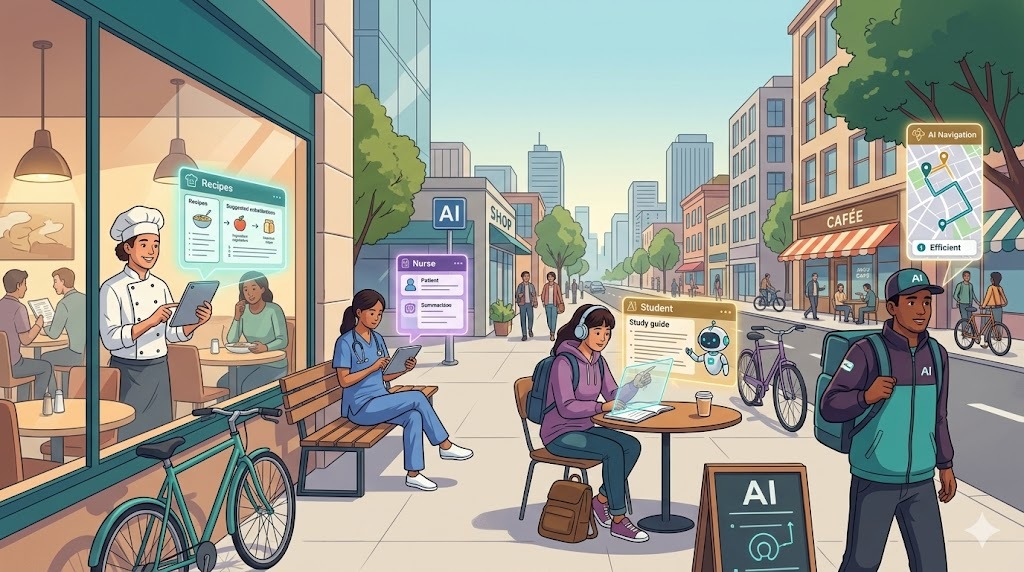
The profile of a typical AI user in 2026 looks nothing like the stereotype of a tech-savvy programmer. Based on usage patterns and surveys, the most active everyday AI users include:
- Students — using AI to understand difficult concepts, check their writing, brainstorm essay arguments, and study for exams (with varying degrees of academic integrity depending on the institution).
- Small business owners — writing marketing copy, customer emails, social media posts, and product descriptions without hiring a copywriter.
- Parents — helping with homework, planning family activities, writing school communications, and explaining complex topics to children in age-appropriate ways.
- Freelancers — handling the administrative and communication workload that doesn’t directly earn money, faster.
- Older adults — using AI to understand technology, draft communications, and get patient, clear explanations of confusing topics. Our guide to AI tools for seniors covers the friendliest options for this group.
- People with disabilities — using AI for reading assistance, writing support, communication help, and task management in ways that meaningfully improve independence.
What People Are Not Using AI For (Yet)
It’s worth being honest about the limits of everyday AI use in 2026. Most regular people are not using AI for:
- Making important financial or medical decisions independently
- Replacing professional relationships with lawyers, doctors, or accountants
- Fully autonomous task completion without human review
- Anything requiring real-time information without a web-enabled AI tool
The people getting the most value from AI in 2026 are those who use it as a capable assistant — not as an infallible authority. They review outputs, apply their own judgment, and treat AI as a first draft rather than a final answer.
How to Start Getting Real Value From AI in 2026
If you’re not yet getting meaningful value from AI tools, the most common reason is approach rather than tool choice. A few practical starting points:
- Pick one real problem in your life and solve it with AI this week. Don’t explore — apply. Find one task you find tedious or difficult and use AI to handle it.
- Be specific in what you ask. “Help me write an email” produces mediocre results. “Help me write a polite but firm email to my landlord about a broken boiler that hasn’t been fixed in three weeks” produces something genuinely useful.
- Use free tools first. ChatGPT, Claude, and Gemini all have capable free tiers. You don’t need to pay to get real value. But be mindful of what you share — our guide on things you should never put into a free AI tool covers the key safety considerations.
Frequently Asked Questions
What are regular people actually using AI for in 2026?
The most common everyday uses are writing assistance (emails, letters, messages), understanding confusing documents, meal planning, learning new topics quickly, trip and project planning, creative projects, and compressing routine work tasks. The pattern is consistently practical — people are using AI to save time and reduce friction on tasks they find difficult or tedious.
Which AI tool do most regular people use in 2026?
ChatGPT remains the most widely used AI tool by volume. Claude is popular for longer, more nuanced writing and document work. Google Gemini is growing fast among people already in the Google ecosystem. For most everyday tasks, any of these free tools will serve regular users well.
Is AI actually useful for non-technical people in 2026?
Yes — and the majority of active AI users in 2026 are non-technical. The tools have become straightforward enough that anyone who can write a text message can get genuine value from them. The learning curve is mostly about learning what to ask for, not about technology.
Are people using AI at work in 2026?
Widely, though not always openly. Many professionals use AI to draft communications, summarise documents, prepare presentations, and handle routine writing tasks — often without formally disclosing it. Organisational policies on AI use vary significantly, and it’s worth knowing your employer’s position before using AI tools with sensitive work information.
What should I avoid using AI for in 2026?
Avoid relying on AI for final decisions on medical, legal, or financial matters without professional verification. Avoid sharing sensitive personal information, passwords, or confidential business data with free AI tools. And treat any AI-generated factual claim that matters — statistics, citations, dates — as a starting point to verify, not a source to trust blindly.
AI in 2026 isn’t the sci-fi story the headlines sometimes suggest. It’s people writing better emails, understanding their lease agreements, planning their dinners, and learning things they were always curious about. The technology is remarkable — but the most compelling thing about it is how ordinary the best use cases actually are.
