I’ll be upfront with you. When I first heard about AI YouTube script writing, I rolled my eyes. It sounded like another overhyped shortcut that would produce robotic, generic content nobody would watch. Then I actually tried it, and my opinion changed completely. If you create YouTube content and you are not using AI to help write your scripts yet, you are spending more time than you need to, and likely leaving views on the table.
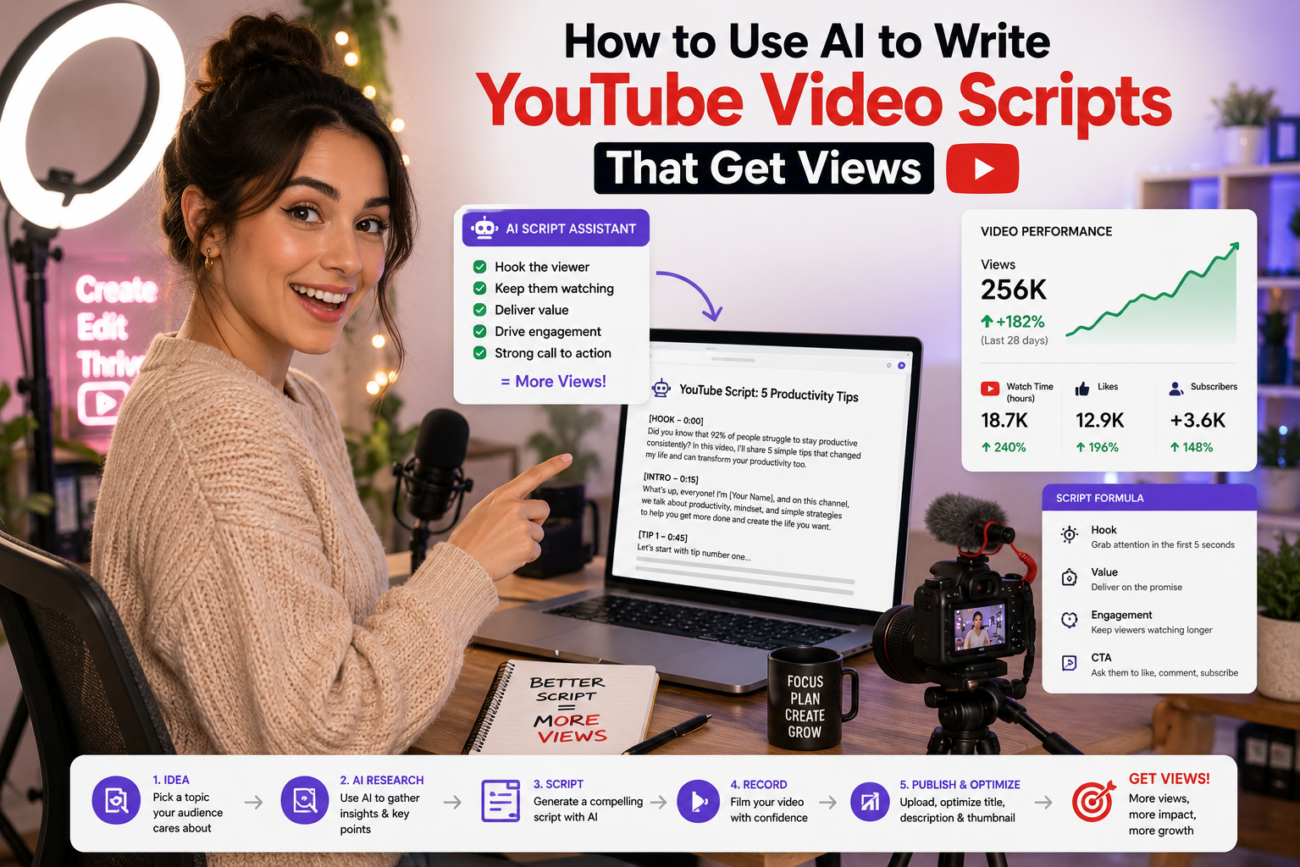
(Image: Creator sitting at desk writing a YouTube script with an AI tool open on screen) Alt text: creator using an AI YouTube script writing tool to plan video content
Why AI YouTube Script Writing Is Worth Your Attention Right Now
Writing a script that hooks viewers in the first 30 seconds and holds their attention until the end is the hardest part of YouTube content creation. It is not filming. It is not editing. It is the words. That is exactly where AI tools are quietly changing the game for creators at every level.
I have had this conversation with dozens of creators over the past year. Most have opinions. Few have actually tested it consistently. I did, and I brought three colleagues along to validate what I was seeing. Their results matched mine closely enough that I felt confident sharing this process publicly.
For a broader overview of how AI is reshaping content creation, Hootsuite's guide to AI content tools it is a solid starting point. If you want to understand how YouTube’s algorithm responds to watch time and retention, YouTube’s official Creator Academy it explains it better than anyone.
The Mistakes I Made Before My AI YouTube Script Writing Process Clicked
When I started, I made every beginner mistake possible:
- I tried to automate everything at once
- I used vague prompts and got generic, unusable output
- I published scripts without editing them into my own voice
- I expected instant results and got frustrated when they did not come
It took a few weeks of trial and error before I found a workflow that actually produced scripts worth recording. Here is that workflow.
(Image: Checklist of AI script writing steps on a laptop screen) Alt text: step-by-step AI YouTube script writing checklist on screen
Step-by-Step AI YouTube Script Writing Process That Actually Works
Step 1: Start with one video format
Do not try to use AI for every type of video you make. Pick one format, whether that is tutorials, listicles, or opinion pieces, and practice with it for at least a week. Trying to do everything at once is how creators burn out and abandon the process entirely.
Step 2: Write a strong brief before you prompt
The quality of your AI YouTube script writing output depends almost entirely on the quality of your input. Before generating anything, define:
- Your target audience and what they already know
- The main keyword or topic you want to rank for
- The single takeaway you want viewers to leave with
- The tone you want, whether conversational, authoritative, or entertaining
Step 3: Use AI for structure, not final copy
This is the shift that made everything click for me. Instead of asking AI to write my scripts, I asked it to outline them. Then I filled in each section with my own voice, stories, and examples. The result felt human because it was mostly human, just organized efficiently by AI.
Tools like ChatGPT and Claude They are excellent for this kind of structural scaffolding. For more YouTube-specific scripting help, Jasper it has templates built specifically for video content.
Step 4: Edit for your voice before you record
Read the script out loud before recording anything. If a sentence sounds like something you would never say in real life, rewrite it. Viewers can tell when a script sounds unnatural, and it kills watch time faster than almost anything else.
Step 5: Analyze, adjust, and repeat
After publishing, check your audience retention graph in YouTube Studio. Find where viewers drop off and ask whether the script was the problem. Use that data to sharpen your next prompt and improve your next script.
(Image: YouTube Studio analytics dashboard showing audience retention curve) Alt text: YouTube Studio retention graph used to improve AI YouTube script writing results
Common Mistakes Creators Make with AI YouTube Script Writing
A few patterns show up again and again among creators who try this and give up:
- Expecting perfection on the first try. AI output is a starting point, not a finished product. Budget time for editing.
- Ignoring their own voice. Scripts that perform best sound like the creator, not like a language model.
- Skipping keyword research. AI cannot tell you what your specific audience wants to watch. Pair it with tools like
TubeBuddyorVidIQto find what is actually being searched. - Giving up too early. Most creators who stick with this process for 30 days see measurable improvement in scripting speed and video performance.
What Surprised Me Most About AI YouTube Script Writing
I expected this to take months before I noticed any real difference. Instead, within the first week of using a structured AI-assisted workflow, I was writing scripts in half the time. The quality was not perfect, but it was good enough to publish, and it kept improving with every iteration.
The creators I have seen succeed with this are almost never the ones who started with advanced tools or complex setups. They started simple. They made mistakes. They iterated. That is the whole process.
You Do Not Need Technical Skills to Start AI YouTube Script Writing
If you can write an email, you can use these tools. There is no coding involved, no steep learning curve, and no expensive setup required. The barrier to entry is lower than most people assume.
Being a beginner can actually work in your favor. You build good habits from day one instead of unlearning bad ones picked up from outdated workflows.
Frequently Asked Questions
Is AI YouTube script writing free? Most tools offer free tiers that are genuinely useful for getting started. Paid plans unlock longer outputs, better customization, and faster generation, but the free versions are absolutely worth testing before committing to anything.
Do I need technical skills for AI YouTube script writing? Not at all. Everything described in this article requires nothing beyond basic computer skills. If you can use a search engine and type a sentence, you can use these tools effectively.
Which AI tool is best for YouTube script writing? It depends on your workflow. ChatGPT and Claude are great for flexible, conversational scripting. Jasper works well if you want YouTube-specific templates. Most creators end up using a combination.
What if I get stuck? Getting stuck is part of the process. Start with a simple prompt, review what comes back, and adjust. The more you use these tools, the better your instincts become for what works and what does not.
The Bottom Line
The best time to start experimenting with AI YouTube script writing was six months ago. The second-best time is today. Pick one video, follow the process above, and see what happens. You might be surprised how quickly things start to click.
