
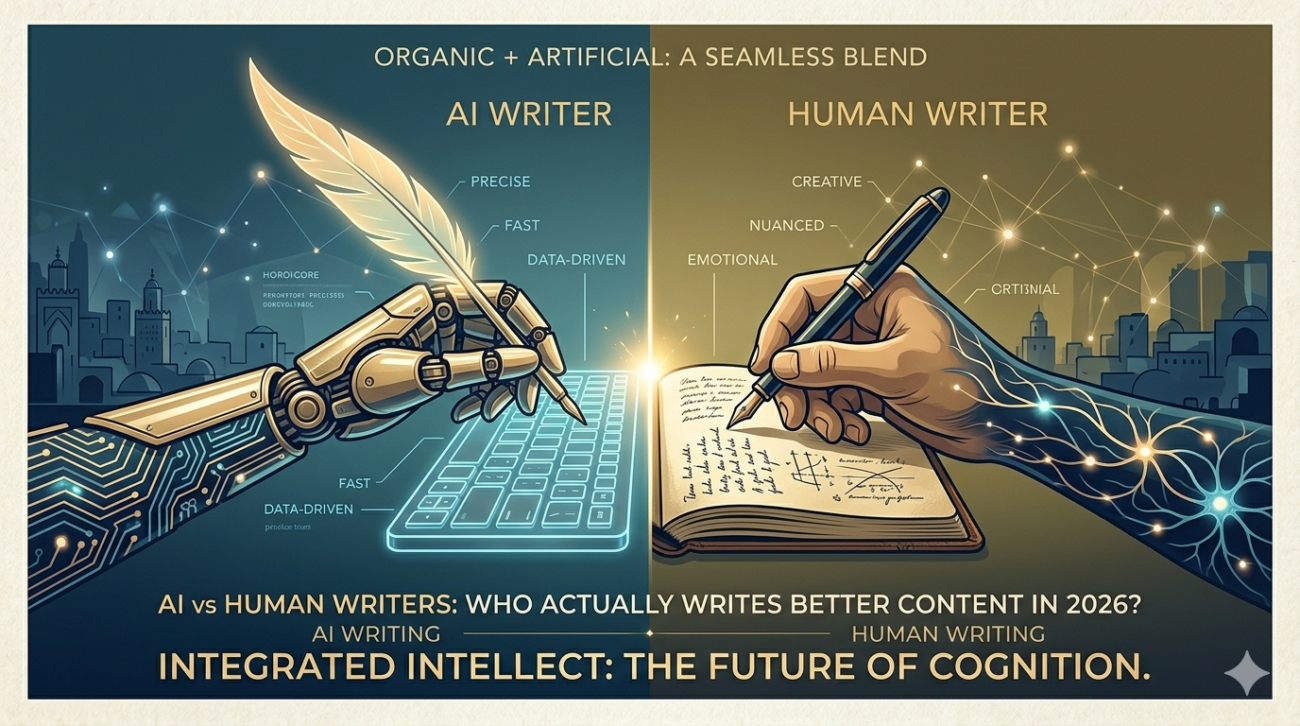
It’s one of the most debated questions in content right now: in a head-to-head matchup of AI vs human writers, who actually produces better content? The honest answer in 2026 is that it depends entirely on what you mean by “better” — and what type of content you’re producing. This is a genuine comparison, category by category, with a clear verdict at the end.
AI vs Human Writers: The Context in 2026
AI writing tools have improved dramatically since the early days of obviously robotic output. ChatGPT, Claude, and Gemini can now produce content that, on a surface read, is indistinguishable from competent human writing. At the same time, the volume of AI-generated content online has exploded, which has made Google and readers simultaneously more sophisticated about detecting it.
Neither AI nor human writers “win” across the board. Each has clear strengths and real weaknesses, and the best content operations in 2026 use both. Here’s how they compare on the dimensions that actually matter.
Speed: AI Wins — and It Isn’t Close
For raw output speed, AI is not in the same category as human writers. A skilled human writer might produce 800–1,200 words of solid copy per hour. An AI tool produces the same volume in under 30 seconds.
For content that needs to be produced at volume — product descriptions, FAQ pages, templated emails, social media variations, location pages — AI’s speed advantage is transformative. What would take a human team days can be produced, reviewed, and published in hours.
Verdict: AI wins decisively on speed.
Quality and Depth: Humans Win — for Now
Speed without quality is worthless, and this is where human writers still hold a meaningful edge — particularly for longer, more nuanced content.
AI writing in 2026 tends to be competent but flat. It covers the expected points, uses appropriate structure, and avoids obvious errors — but it rarely surprises the reader, makes an unexpected connection, or demonstrates genuine expertise built from real-world experience. It writes about topics; experienced human writers write from inside them.
The gap is most visible in:
- Investigative and reported content — AI cannot conduct interviews, make phone calls, or observe events firsthand.
- Opinion and analysis — genuine point of view, built from years of experience and personal conviction, remains distinctly human.
- Technical expert content — a cardiologist writing about heart disease brings something that an AI trained on existing content cannot replicate.
- Culturally resonant writing — humour, irony, timing, and cultural specificity are areas where AI consistently underperforms.
Verdict: Humans win on quality and depth for complex, expert, or opinionated content.
SEO Performance: More Complicated Than You Think
This is the category with the most misinformation circulating. The reality in 2026:
Google has stated clearly that it does not penalise AI-generated content as a category — it penalises low-quality, unhelpful content regardless of how it was produced. AI content that is accurate, well-structured, and genuinely useful to the reader can rank just as well as human-written content. AI content that is thin, generic, or fails to satisfy search intent will struggle — just as equivalent human-written content would.
In practice, the SEO performance gap comes down to a few factors:
- Originality — AI tends to produce content that resembles the average of what already exists. Human writers are more likely to produce original angles, new research, and genuine insights — all of which Google rewards.
- E-E-A-T — Google’s emphasis on Experience, Expertise, Authoritativeness, and Trustworthiness increasingly favours content with demonstrable human expertise and first-hand experience.
- Depth of coverage — well-prompted AI can cover a topic comprehensively, but often misses the nuanced sub-questions that a true expert would address. This affects how completely a piece satisfies search intent.
If you want better SEO results from AI-assisted content, learning how to write better AI prompts makes a significant difference in output quality.
Verdict: Neither wins inherently — quality and relevance determine SEO performance, not the source.
Creativity and Voice: Humans Win
Genuine creative voice — the thing that makes a reader feel like they’re hearing a specific person think — remains distinctly human. AI can mimic styles and produce technically competent creative writing, but it defaults to the centre. It reads like a composite of everything it has read, which means it rarely takes creative risks or has a distinctive perspective.
Brand voice is a related challenge. AI can be prompted to write in a specific tone, but maintaining a consistent, nuanced brand voice across months of content — including knowing when to deviate from it for effect — requires human judgment. The best AI-assisted content operations use human writers to establish and maintain voice, with AI handling volume production within guardrails set by those humans.
Verdict: Humans win on creativity, originality, and distinctive voice.
Cost: AI Wins at Scale
A freelance content writer in 2026 charges anywhere from $50 to $500+ per article, depending on expertise and topic complexity. An AI tool subscription costs $20–$40 per month for unlimited output. For businesses that need high volumes of content, the economics of AI are impossible to ignore.
However, the true cost calculation is more nuanced. AI content still requires human review, editing, and fact-checking to be publishable at a professional standard. And cheap, high-volume AI content that doesn’t rank or convert isn’t saving money — it’s wasting it. The cost advantage is real but conditional on quality control processes being in place.
Verdict: AI wins on cost at volume, with caveats.
Accuracy and Fact-Checking: Humans Win
AI hallucination — confidently stating things that are factually wrong — remains a meaningful problem in 2026. AI writing tools do not verify facts; they generate text that fits the pattern of what sounds true. For any content involving statistics, research citations, medical information, legal details, or current events, human fact-checking is non-negotiable.
This is one of the most important things to understand about the AI vs human writers debate: AI can produce text that looks authoritative while being factually incorrect. Human writers get things wrong too — but a knowledgeable human writer is less likely to confidently fabricate a statistic. For more on this, see our piece on how ChatGPT actually works and why hallucination happens.
Verdict: Humans win on accuracy — AI content always needs fact-checking.
The Honest Verdict: Neither Wins — The Best Use of Both
In 2026, the AI vs human writers debate has largely been settled among serious content professionals: the answer is not either/or. The content operations getting the best results use AI for speed, volume, and first-draft production — and human writers for expertise, voice, fact-checking, editing, and anything requiring genuine originality or real-world experience.
The writers most at risk are not those competing with AI — it’s those refusing to work alongside it. A human writer who uses AI tools effectively can produce more, faster, while focusing their own energy on the parts of writing that actually require a human. That’s a competitive advantage, not a threat. For a broader look at how AI is changing professional roles, our piece on whether AI is going to take your job addresses the bigger picture.
Frequently Asked Questions
Is AI writing better than human writing in 2026?
For speed and volume, yes. For depth, originality, expertise, and distinctive voice, no. AI writing is competent and fast; human writing at its best is something AI cannot replicate. The most effective content in 2026 combines both AI for production efficiency and humans for quality, voice, and accuracy.
Will AI replace human writers?
Not entirely — but it has already displaced some writing roles, particularly those involving high-volume, low-complexity content like product descriptions and templated copy. Skilled writers who develop original insights, expert knowledge, and a strong voice are significantly more resilient. Writers who use AI as a tool rather than fearing it as a competitor are best positioned.
Can Google tell the difference between AI and human writing?
Google has stated it does not target AI content specifically — it targets low-quality content. In practice, Google’s systems reward originality, depth, and genuine expertise, which currently favours human-written content in competitive niches. Well-crafted, helpful AI content can rank well; generic AI content typically does not.
What type of content should AI write vs humans?
AI is well-suited to: first drafts, high-volume templated content, FAQ sections, product descriptions, email sequences, and summarisation. Human writers are better for: expert analysis, investigative reporting, opinion pieces, brand storytelling, sensitive topics, and anything requiring first-hand experience or cultural nuance.
How do I use AI writing tools without hurting my content quality?
Treat AI output as a first draft, not a finished product. Always fact-check statistics and specific claims. Edit for voice and add genuine insight from your own expertise. Use strong, specific prompts to get better raw material. And never publish AI content that you haven’t read carefully — the cost of a hallucinated fact or off-brand paragraph is higher than the time saved.
The AI vs human writers debate will continue — but the most honest answer in 2026 is that it’s the wrong question. The right question is how to use both effectively. AI handles the volume; humans handle the craft. Together, they produce more and better content than either could alone.
