
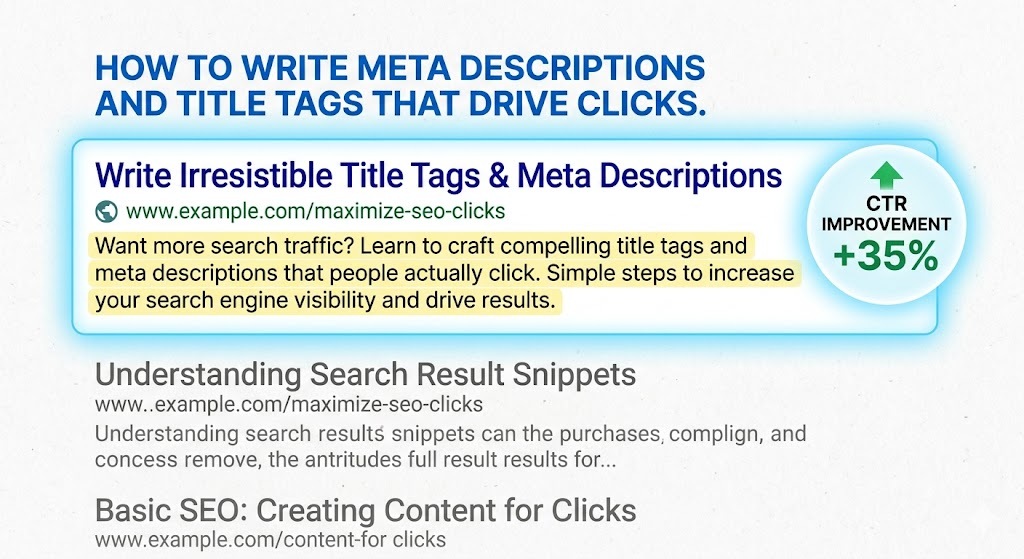
AI Meta Descriptions Title Tags: Boost Your Click-Through Rate
Here is a question I get asked constantly. Is using AI for meta descriptions and title tags actually worth it, or is it just another overhyped shortcut? I spent a month testing it across multiple blogs before forming an opinion, and what I found surprised me. Done correctly, AI meta descriptions and title tags can meaningfully improve your click-through rate from search results without requiring any technical skills or expensive tools. This guide shows you exactly how.
Why AI Meta Descriptions and Title Tags Matter More Than Most Bloggers Realize
Your title tag and meta description are the first things a searcher sees before clicking. They are your billboard on Google. Yet most bloggers treat them as an afterthought, either leaving them blank and letting Google auto-generate something generic, or writing them quickly without any strategic thought.
Click-through rate is a direct signal Google uses to evaluate whether your content deserves its ranking position. A post ranking in position three with a compelling title tag and meta description will often outperform a position one result with a weak one. That means improving these two elements alone can drive more traffic without changing a single word of your actual content.
For the technical specifications that govern how these elements display in search results, Google's official guidance on title links and meta descriptions These are the definitive references. For data on how click-through rates vary by position and industry, Backlinko's CTR study It is the most cited independent research available.
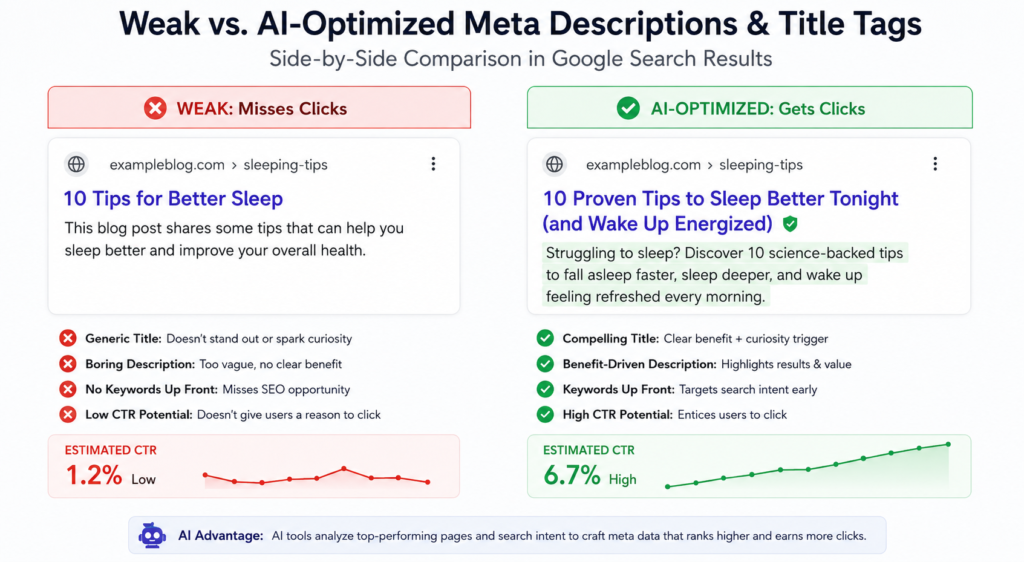
What Nobody Tells You About Writing AI Meta Descriptions and Title Tags
I made every mistake possible when I started using AI for this. I asked for generic outputs, accepted the first suggestion without testing alternatives, and ignored character limits entirely. The results were mediocre at best.
Over two weeks of consistent testing, I figured out that the quality of AI meta descriptions and title tags depends almost entirely on the quality of your prompt. Vague prompts produce vague output. Specific, structured prompts produce copy that actually earns clicks. Here is the system that works.
Step-by-Step Process for Writing AI Meta Descriptions and Title Tags
Step 1: Gather your inputs before prompting
Before opening any AI tool, collect the following:
- Your focus keyphrase
- The search intent behind that keyphrase (informational, commercial, or navigational)
- The primary benefit your post delivers to the reader
- One specific detail that makes your post different from the top-ranking competitors
- Your target character limits (title tags: 50 to 60 characters, meta descriptions: 150 to 160 characters)
Having these inputs ready transforms a generic AI output into something genuinely competitive.
Step 2: Use a structured prompt template
In ChatGPT or Claude, use a prompt structured like this:
“Write five title tag options and five meta description options for a blog post about [topic]. The focus keyphrase is [keyphrase]. The post helps readers [primary benefit]. Keep title tags under 60 characters and meta descriptions under 160 characters. Use an active, benefit-driven tone. Include the keyphrase naturally in each option.”
Ask for five variations, not one. Having options to compare is what separates good AI meta descriptions and title tags from great ones.
Step 3: Filter by these four criteria
Once you have your AI-generated options, evaluate each one against these criteria:
- Keyphrase placement. Does the title tag include the keyphrase, ideally near the beginning?
- Benefit clarity. Does the meta description tell the reader exactly what they will gain by clicking?
- Character count. Does it fit within the display limits without being truncated?
- Differentiation. Does it offer something the competing results in the top ten do not?
Use Portent's SERP Preview Tool or Mangools' SERP Simulator to preview exactly how your title tag and meta description will appear in Google search results before publishing.
Step 4: Test variations using Google Search Console
After publishing, monitor your click-through rate in Google Search Console under the Performance report. If a post has high impressions but a low CTR, that is a direct signal that your title tag or meta description is not compelling enough. Go back to your AI tool, generate new variations, update the post, and track the change over the following two to four weeks.
This iterative process is where the real gains come from. Most bloggers write one title tag and never revisit it. Treating it as a testable variable is what separates bloggers who grow from those who plateau.
Step 5: Build a swipe file of your best performers
Every time a title tag or meta description you wrote with AI produces a notably high CTR, save it. Over time, you will build a personal swipe file of formulas and structures that work specifically for your audience and niche. Feed those examples back into your AI prompts as references to replicate what is already working.
AI Title Tag Formulas That Consistently Perform Well
These structures work reliably across most niches when used as the basis for AI prompts:
- Number + Keyphrase + Outcome: “7 AI Meta Description Tips That Double Your CTR”
- Keyphrase + Colon + Specific Promise: “AI Title Tags: Write Once, Rank Faster”
- Question format: “Are Your Title Tags Killing Your CTR? Fix It With AI”
- Year + Keyphrase + Action: “2026 Guide to AI Meta Descriptions That Get Clicks”
- How-to + Keyphrase + Benefit: “How to Write AI Meta Descriptions That Actually Get Clicked”
Ask your AI tool to generate variations using each of these structures and then select the strongest option based on your four-criteria filter.
Common Mistakes to Avoid with AI Meta Descriptions and Title Tags
- Ignoring character limits. Title tags over 60 characters get truncated in search results. Meta descriptions over 160 characters get cut off. Always check the length before publishing.
- Keyword stuffing. Cramming the keyphrase multiple times makes the copy feel unnatural and reduces click-through rates. One natural inclusion is enough.
- Writing for Google instead of the reader. The goal of a meta description is to earn a click from a human being, not to satisfy an algorithm. Write copy that speaks directly to what the searcher wants.
- Using the same meta description template for every post. Different posts serve different intents. A how-to post needs a different meta description structure than a product comparison or an opinion piece.
- Never testing or updating. Title tags and meta descriptions are not set-and-forget elements. Revisit your lowest-CTR posts every quarter and use AI to generate fresh alternatives.
What Surprised Me Most About This Process
I expected improving meta descriptions and title tags to be a minor, incremental gain. Instead, within the first week of systematically rewriting my lowest-CTR posts using AI-generated variations, I saw measurable click-through rate improvements on several posts without changing their rankings at all. The content stayed the same. Only the billboard changed.
The bloggers I have seen get the most out of this process are not the ones who wrote the cleverest copy on the first try. They are the ones who treated it as an ongoing testing process and kept iterating based on real data.
Internal Links to Build Into This Post
Connect this post to your existing content to build topical authority across your AI blogging cluster:
- Link to your AI SEO blog writing guide when discussing on-page optimization as a broader context for title tags
- Link to your AI blogging after the Google core update post, when covering how CTR signals affect rankings
- Link to your AdSense approval AI blog guide when mentioning how click-through rates affect overall site quality signals
- Link to your AI blog niche research post when discussing how keyphrase selection affects title tag strategy
You Do Not Need Technical Skills to Start
If you can type a prompt and copy text into a WordPress field, you have everything you need to start improving your AI meta descriptions and title tags today. There is no coding, no plugin configuration beyond a basic SEO plugin like Yoast or Rank Math, and no advanced analytics setup required.
Being a beginner is an advantage here. You are not locked into old habits of writing title tags on autopilot. You can build a data-driven, AI-assisted process from day one.
Frequently Asked Questions
Do I need technical skills to write AI meta descriptions and title tags? Not at all. The entire process described above requires nothing beyond basic computer skills and access to a free AI tool. If you can use email, you can implement this workflow today.
How long does it take to see CTR improvements from better title tags? Most bloggers see measurable changes within two to four weeks of updating their title tags and meta descriptions. Google recrawls updated pages relatively quickly, and CTR changes show up in Search Console within days of the update going live.
Which AI tool works best for writing meta descriptions and title tags? ChatGPT and Claude both perform well for this task when given structured prompts. For more SEO-specific output, Surfer SEO and Semrush's AI writing tools include meta description generators built around keyword data.
How many variations should I generate before choosing one? Generate at least five variations for both the title tag and meta description. Having options to compare forces you to evaluate rather than just accept the first output. The best option is rarely the first one.
What if I get stuck writing prompts that produce good output? Start with the template provided in Step 2 above and adjust one variable at a time. The more specific your brief, the better your output. If results are still generic, add a competitor example to your prompt and ask AI to write something better than that specific example.
The Bottom Line
AI meta descriptions and title tags are one of the highest-leverage, lowest-effort improvements you can make to an existing blog. You are not changing your content. You are changing how it appears to searchers, and that alone can move the needle on traffic significantly. Try it on your five lowest-CTR posts this week and track what happens. You might be surprised how quickly things shift.
