I have tested a lot of blogging strategies over the years. Most of them stopped working within a year. But AI blogging after Google’s March core update is a different conversation entirely, because this update did not just shift rankings. It changed the rules of what qualifies as valuable content. If you run an AI-assisted blog and you have noticed traffic drops, ranking fluctuations, or slower growth than expected in 2026, this guide explains exactly what happened and what to do about it.
What Google’s March Core Update Actually Changed for AI Bloggers
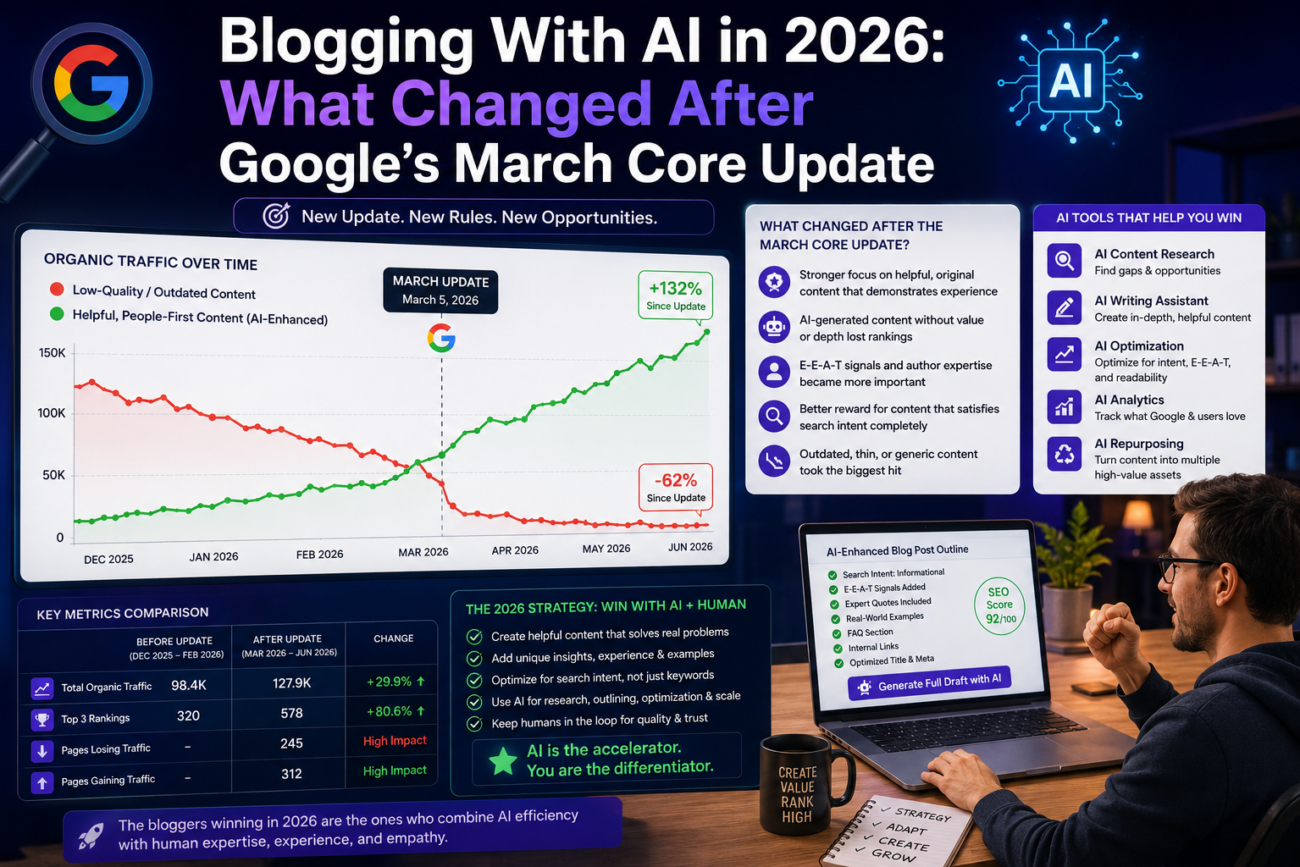
Google’s March 2026 core update was one of the most significant algorithm shifts for content creators since the Helpful Content Update of 2022. The core focus was the same as it has always been: reward content that genuinely helps people and demote content that exists primarily to rank. But the execution became far more sophisticated.
Three specific changes hit AI bloggers hardest:
- Improved AI content detection signals. Google got significantly better at identifying patterns common in unedited AI output, including repetitive sentence structures, generic examples, and a lack of first-person specificity.
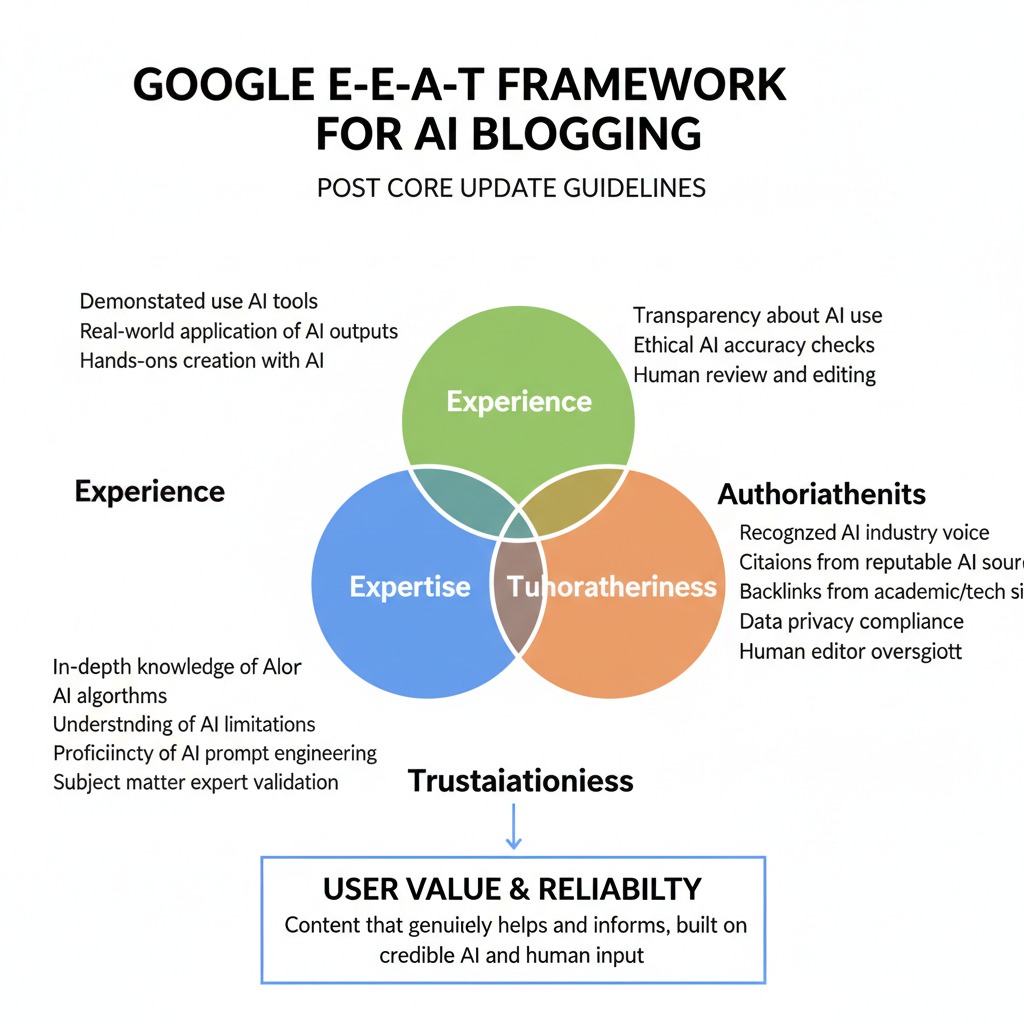
- Stronger emphasis on Experience signals. The E in Google’s E-E-A-T framework (Experience, Expertise, Authoritativeness, Trustworthiness) became a more prominent ranking factor. Content that demonstrates lived experience outperforms content that merely summarizes information.
- Reduced tolerance for thin topical coverage. Sites that published broadly across many unrelated topics without building genuine depth in any of them saw significant ranking drops.
For the official explanation of how Google evaluates content quality, Google's Search Quality Rater Guidelines are the primary reference. For ongoing updates on algorithm changes, Search Engine Journal's Google algorithm update tracker is the most reliable independent source.
What Nobody Tells You About AI Blogging After a Core Update
I made every mistake possible when I first started AI-assisted blogging. I overcomplicated my workflow, trusted raw AI output too much, and published content that technically answered questions but offered nothing a reader could not get from a basic search. After the March update, that approach stopped working almost overnight.
Here is what I learned after two weeks of testing and adjusting:
The bloggers who survived and grew after this update were not the ones who stopped using AI. They were the ones who used AI differently. The update did not punish AI assistance. It punished AI dependency. That distinction matters enormously for how you structure your workflow going forward.
The AI Blogging Strategy That Still Works After the Core Update
Step 1: Lead with experience, use AI to expand
Every post should start with something only you can provide: a real observation, a specific result, a mistake you made, or a question a reader asked you directly. Write that opening yourself. Then use AI tools like ChatGPT or Claude to help you expand, structure, and optimize the rest of the post around that human foundation.
This approach satisfies Google’s Experience signals while still giving you the speed and efficiency benefits of AI assistance.
Step 2: Build topical authority, not just individual posts
The March update rewarded sites that demonstrated deep expertise in a specific area. If your blog covers ten unrelated topics, pick the two or three where you have the most genuine knowledge and double down on those. Use AI blog niche research to identify the subtopics within your chosen area that have search demand but limited quality coverage.
Internally, link your posts together to signal topical depth. For example, if you have already published guides on AI SEO blog writing, AdSense approval for AI blogs, and AI blog niche research, those posts should all link to each other and to this one. That interconnected structure tells Google your site has genuine authority on AI-assisted blogging, not just isolated posts on random topics.
Step 3: Rewrite your weakest posts before publishing new ones
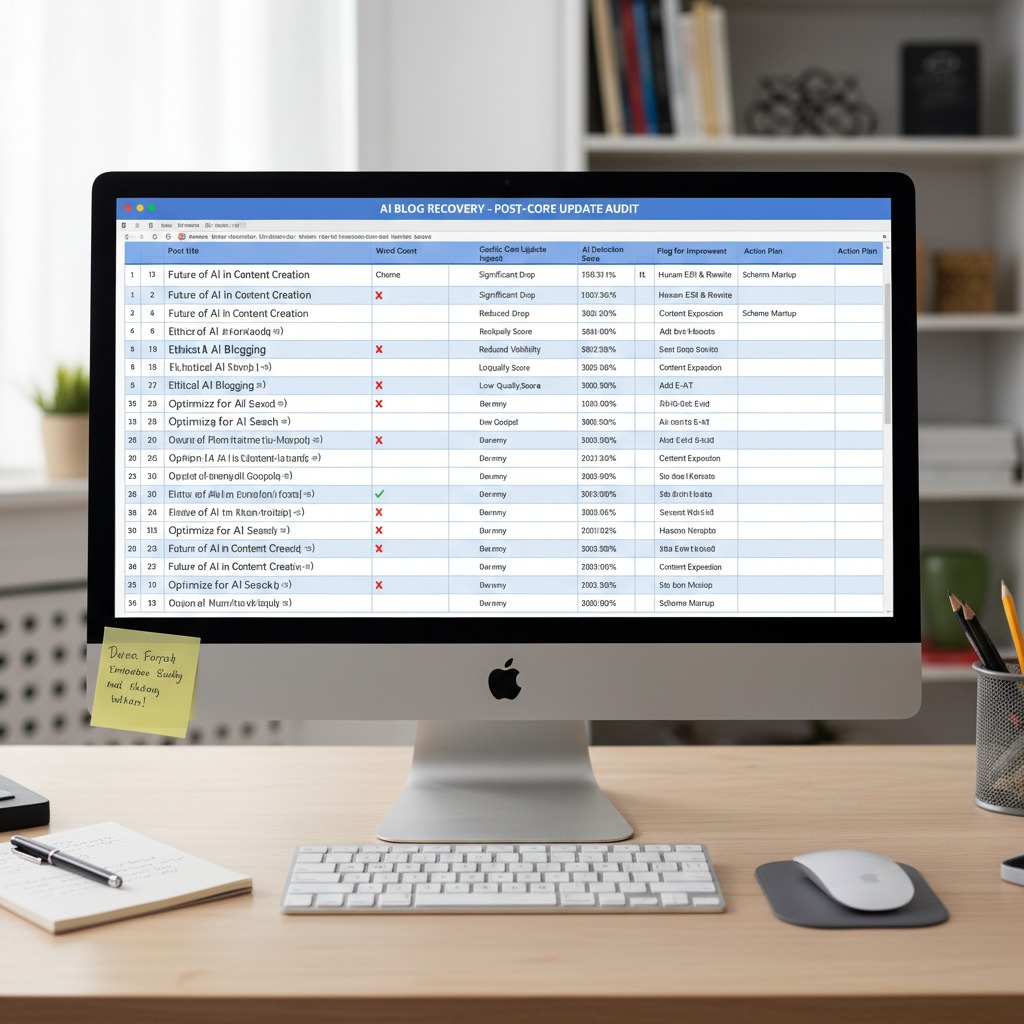
After a core update, the fastest path to traffic recovery is almost never publishing more content. It is improving what you already have. Audit your existing posts and identify the ones with high impressions but low click-through rates in Google Search Console. Those are your priority targets.
Use AI to help you restructure those posts, but add new personal examples, updated statistics, and stronger introductions that demonstrate firsthand experience. Then resubmit them for indexing.
Step 4: Optimize for E-E-A-T signals throughout your site
Beyond individual posts, your site as a whole needs to signal trustworthiness. After the March update, these on-site elements carry more weight than before:
- A detailed About page that explains your background and why you are qualified to write about your niche
- Author bios on every post with real credentials or relevant experience
- Citations and outbound links to authoritative sources within your content
- A clear editorial process or disclosure about how you use AI in your writing
Tools like Surfer SEO and Clearscope can help you optimize individual posts for topical completeness, which is a proxy for the expertise signals Google is looking for.
Step 5: Monitor, adapt, and stay current
Core updates roll out over weeks, and their effects continue to settle for months afterward. Do not make dramatic changes to your entire site based on one week of data. Use Google Search Console and Ahrefs to track ranking changes at the post level, identify patterns in what is gaining versus losing visibility, and adjust your strategy based on actual data rather than speculation.
Follow Google's Search Central Blog directly for official guidance. Third-party commentary is useful for context, but the primary source should always be Google itself.
What to Watch Out for in Your AI Blogging Workflow
Several patterns consistently hurt AI bloggers after the March update:
- Publishing without a personal layer. If your post could have been written by anyone with access to the same AI tool, it will not rank well. Add specificity that only you can provide.
- Ignoring your existing content. New posts on a site with weak existing content inherit that weakness. Fix your foundation before expanding.
- Over-relying on AI for E-E-A-T signals. AI cannot fabricate a genuine experience. It can help you articulate and structure your experience, but the raw material has to come from you.
- Chasing algorithm speculation. After every core update, the internet fills with theories about what Google changed. Most of it is guesswork. Stick to official sources and your own data.
- Treating the update as permanent. Core updates are refined over time. Sites that were incorrectly penalized often recover in subsequent updates if they continue improving their content quality.
What Surprised Me Most About Adapting to This Update
I expected the recovery process to take months. Instead, within the first week of applying the strategy above, specifically leading with personal experience and improving my weakest posts, I started seeing early positive movement in Search Console. Not dramatic, but directional. And that was enough to confirm the approach was working.
The bloggers I have seen recover fastest from this update are not the ones who panicked and overhauled everything. They are the ones who made targeted, data-driven improvements and stayed consistent. That is the approach I recommend.
This Applies to Your Situation Too
You might be wondering whether this applies to your specific blog. When I was first adjusting my strategy, I kept thinking the advice was too general to be useful for my niche. It was not. The principles are universal. The execution just needs to be adapted to your topic, your audience, and your existing content library. Start with one post, apply the framework, and see what happens.
Frequently Asked Questions
Is AI blogging after the Google core update still viable? Absolutely. The update did not penalize AI assistance. It penalized low-quality, thin content regardless of how it was produced. AI-assisted blogs that prioritize genuine value, personal experience, and topical depth are performing well in 2026.
Do I need technical skills to adapt my AI blogging strategy? Not at all. The adjustments described in this guide require nothing beyond basic content editing and familiarity with Google Search Console, which is free and straightforward to use. If you can write an email, you can implement this strategy.
How long does recovery take after a core update? Recovery timelines vary. Some sites see improvement within weeks of making targeted changes. Others take two to three months, particularly if the issues are widespread across many posts. Consistency and patience are more important than speed.
Is AI blogging after the core update free to adapt to? The core strategy changes described here cost nothing to implement. Free tools like Google Search Console and Google’s Search Quality Rater Guidelines give you everything you need to audit and improve your content. Paid tools like Ahrefs and Surfer SEO accelerate the process but are not required.
What if I get stuck figuring out what to fix first? Start with your highest-impression, lowest-click-through posts in Search Console. Those are the posts Google is already showing to searchers, but they are not compelling enough to earn the click. Improving those titles, introductions, and meta descriptions is the highest-leverage starting point.
The Bottom Line
AI blogging after Google’s March core update is not harder. It is just more intentional. The bloggers who treat AI as a tool for enhancing their own expertise, rather than replacing it, are the ones building sustainable traffic in 2026. Apply the strategy above for one week and track what changes. The proof is always in the results.
